Filteredwaterguide.com is supported by readers. If you purchase through referral links on our site, we make a commission at no extra cost to you. Learn more.
Reverse Osmosis vs Distilled Water
During your search to find the best water purification method for you and your family, you might have read about reverse osmosis filtration and water distillation.
That’s not surprising because each of these water purification methods can remove 99% or more of the many impurities that are commonly found in tap water. So, which one is right for you?
The answer to that really comes down to practicality. I am about to discuss that in more detail along with describing how reverse osmosis filtration and water distillation work. I will also point out the advantages and disadvantages of each.
By the time that you are finished reading about reverse osmosis vs distilled water purification, you will clearly see why reverse osmosis filtration is the better choice for your home water purification needs.

Is Reverse Osmosis Water Same as Distilled Water?
The answer to this question is no.
That’s because even though each of these water purification methods can produce extremely high-quality drinking water, they go about doing it in a completely different way. This means the composition of the finished water that each produces tends to have different types of leftover impurities in it.
Reverse osmosis is very good at removing or reducing such contaminants as fat molecules, organic bacteria, viruses, metal ions (such as lead and copper), aqueous salts, nitrates, chloride, and sulfates.

Distillation almost completely removes all sodium, hardness-causing compounds (ex: calcium and magnesium), dissolved solids (ex: iron and manganese), fluoride, nitrates, organic compounds, and some heavy metals.
So why even though they remove some similar contaminants, there are some water impurities that each method does not remove or reduce effectively.
Examples of this is distillation is not impactful when it comes to removing mercury and reverse osmosis does not remove dissolved gases such as foul odor-causing hydrogen sulfide.
You can expect this to become clearer as you read on and find out in more detail how each of these water purification methods works.
What is Reverse Osmosis?
Reverse osmosis is a water treatment method that uses special membranes to filter contaminants out of water.
It was first used back in the 1700s but it was not until the late 1900s when the membranes started being made out of special polymers that it became a cost-effective and mainstream water filtration process.
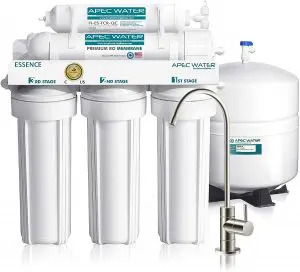
Here are the steps it takes for a reverse osmosis filter to produce high-quality drinking water:
- Tap water enters into the system and first has larger solids removed by some form of pretreatment filter. This cuts down on the effort it takes to keep the unit’s semi-permeable membrane working efficiently.
- Water under pressure next comes into contact with the unit’s main semi-permeable membrane. These membranes are designed to let solvents (such as water) pass through them but larger solutes (solids) cannot. The water that comes out the other side of the membrane is now very pure and gets stored in a small tank.
- The solids that are left behind on the supply side of the filter are then washed out of the system.
Advantages
Here are some of the reasons why people choose to use reverse osmosis filtration over other water purification methods:
- Reverse osmosis almost completely removes several of the most common impurities that are found in tap water. This results in very high-quality drinking water for those that use this type of water purification method.
- It removes chlorine and fluoride which will help significantly improve water taste and smell in most cases.
- This water purification method requires no heating or electricity to make it work. That means there are very few operating costs once it’s been put into place. This makes it much more cost-effective than buying bottled purified water.
- Quality water production happens in a very short amount of time. They also have included storage tanks for quick drinking water access.
- These can easily be made to work in tandem with water softeners and other types of water purification systems.
- Good reverse osmosis systems can also stop hard water deposits and stains.
Disadvantages
Here are some of the drawbacks that are associated with reverse osmosis filtration:
- This water purification method is non-selective. That means you will remove some essential minerals as well as some of the more harmful ones.
- The initial setup can be costly. A good quality reverse osmosis water filtration system can easily run you between $500 and $1000.
- These water filtration systems produce a lot of wastewater. This is because they use a backwash system to keep the membranes in them clean.
- For most, they will require professional installation. This only adds to their already high initial cost.
- Although they produce high-quality drinking water, they may still need to be supplemented by other types of water filtration devices to produce superior quality water.
- The pores in the membranes may clog up over time.
- Because they do not remove dissolved gases, this can result in the water they produce having a lower PH which is not always healthy and can be a skin and eye irritant.
What is Distillation?
Distillation is one of the oldest ways that man has used to purify water. The fact that it’s used in hospital settings to mix medicines and to help clean surfaces that need to be extremely sterile is a testament to how pure the water from the distillation process is.
It differs greatly from reverse osmosis because there are no actual filters or semi-permeable membranes that are used in the process.
This water purification method works by using a simple three-step process that is as follows:
- Source water will first enter into a collection vessel where it’s super-heated until it becomes steam.
- This steam will then travel to a second collection vessel. During this part of the process, all of the impurities in the incoming tap water that have a boiling point greater than that of water (which includes most impurities that are found in water) will be left behind.
- The second containment vessel is pressurized so it can turn the water vapor back into liquid H2O. This water is now in a highly purified state. At the same time, the impurities that are left behind in the first containment vessel are flushed out of the system.

Advantages
Here are some of the pros associated with water distillation.
- It removes almost 100% of some of the major impurities that are commonly found in tap water. This includes most solids and dangerous heavy metals.
- Distillation produces drinking water that is suitable for those who are on low sodium diets.
- It’s known to inactivate waterborne bacteria, viruses, and other biological contaminants.
- This water purification method produces consistent results and requires very little maintenance.
Disadvantages
These are some of the reasons that you may not want to use distilled water:
- It removes just about everything from tap water including some essential nutrients. So, you may end up needing to take nutritional supplements. This also results in the water having a very bland taste in most cases.
- This is not a very practical method for producing large quantities of purified water. It also takes some time to work.
- Most people would prefer not to have an additional high heat source around their homes and simple distillation requires a great amount of energy.
- It will not remove all of the chemicals that are commonly found in household water (such as petroleum-based compounds and radon). Some of which can even form dangerous compounds during the water superheating process.
- This water purification method takes some time.
RO vs Distilled Water: Which is Better?
There really is not a bad choice here. So, for me, the answer to this question simply comes down to practicality.
Distillation produces some very high-quality drinking water. It also would not be a big problem to purchase a small distiller setup to slowly make distilled water for such specific uses as non-staining water for ironing or if you need to drink water that will not add to your salt intake.
But for producing purified water on a larger scale, it would take a big distillation setup that also would be somewhat costly to run.
Reverse osmosis systems also produce high-quality drinking water but they cost little to run once they have been installed. They will also almost effortlessly produce a generous amount of very pure water for many years to come.
This is why I feel that for most people reverse osmosis filtration is a simpler, faster, less expensive, and more practical choice for home water purification.