Filteredwaterguide.com is supported by readers. If you purchase through referral links on our site, we make a commission at no extra cost to you. Learn more.
If you find that you need a lot of soap to create a lather, your skin has a residue after showering, or your appliances and pipes frequently suffer from limescale damage your home has hard water.
Luckily, you can eliminate all these problems immediately simply by installing a water softener.
But what exactly is a water softener and how does it work?
Also Check Out: Top Rated Water Softener Reviews and Buyers Guide

A water softener can either remove the minerals that are making your water hard or change the structure of those minerals to stop them adhering to surfaces. Although they are usually sold as water softeners, the latter are actually water conditioners.
This is because they do not actually remove minerals from water, meaning water is still technically hard — although, in most ways, the water does behave as if it were soft.
Other Helpful Resources:
Hard water is defined as having at least 7 grains per gallon of calcium carbonate or at least 60 milligrams per liter of calcium and magnesium. More than 85 percent of the population in the U.S. receive hard water. These people need to dedicate time every week to cleaning the scale left on places like faucets and shower heads, suffer from dry skin, throw out appliances prematurely, and waste water waiting for soap to lather.
With soft water, on the other hand, you have none of these problems.
For more information on how hard water becomes soft check out our how to soften hard water guide.
How a water softener works depends on whether it removes minerals or changes the structure of minerals.
The softeners that remove minerals use a process called ion exchange. This involves exchanging calcium and magnesium ions for sodium ions.
Hard water enters the softener system and then passes through a bed of resin beads that are negatively charged with sodium ions.
Calcium and magnesium ions are positively charged, meaning they are attracted to the negative charge. As a result, the ions stick to the resin beads.
In turn, the beads release their sodium ions. The water that flows out of the system contains these sodium ions instead of the calcium and magnesium ions that were making the water hard.
Helpful Resources:
This water softening process flow diagram shows how the ion exchange works.

Softeners that change the structure of minerals in water use a different process. In fact, there are a couple possible methods. The most common is template-assisted crystallization (TAC). As the water softener diagram below shows, TAC works by sending water through polymeric beads. These beads turn magnesium and calcium into crystals that are unable to stick to surfaces.

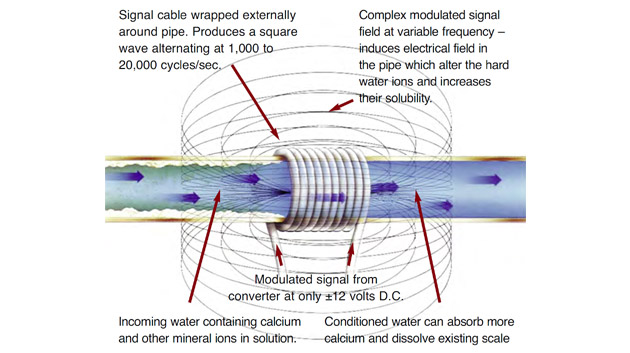
Another type of water softener is the magnetic water scaler. This type of water softener creates an electrical field inside the pipe to change the form of the calcium and magnesium ions, making them less soluble.

Models that use ion exchange to soften water are salt water softeners. Those that change the structure of minerals are salt-free softeners.
As they are more effective, salt softeners are the only option for homes with extremely hard water. However, homeowners who would prefer not to increase sodium levels of water may prefer a salt-free softener. These also have the benefit that they cost less to run and require less maintenance, as there is no refilling a brine tank with salt every few weeks.
Helpful Resource: When to Add Salt to A Water Softener
In systems that use ion exchange, the resin needs to regenerate. This allows the resin beads to keep exchanging sodium ions for magnesium and calcium ions.
The regeneration process involves washing the hard minerals off the beads and then flushing the minerals from the softener system.
Typically, it depends on the water softener and the household to determine how often a water softener will regenerate. For more information on water softener regeneration time and details see our regeneration guide here.
A water softener that uses the ion exchange method also has more parts than the other kinds of systems. There are three main components: a mineral tank, a brine tank, and a control valve.
Hard water enters the mineral tank for the ion exchange process. Once the ions are exchanged, the water exits from the bottom and continues through the pipe to your appliances and faucets.
The brine tank is the shorter of the two tanks — it’s also the one you need to fill with salt pellets or blocks. Whenever it’s time for the system to regenerate, the solution inside the brine tank leaves and heads to the mineral tank to flush the resin with fresh salt.
As resin beads only have a limited capacity, it’s useful for the system to measure how much water passes into the mineral tank. This ensures the softener remains effective. Once the resin is saturated, the system regenerates.
Water softeners that use the ion exchange process only remove calcium and magnesium from your water. Those that change the structure of minerals remove no contaminants at all.
With soft water, you consume fewer potentially-harmful minerals when you drink tap water. However, it is important to note that a water softener is not a filtration device — the water may still contain sediment and dangerous contaminants like rust, herbicides, pesticides, fluoride, parasites, and bacteria. If you receive your water from a city supply, it most likely also has a high quantity of chlorine, which can lead to an unpleasant taste or smell.
If you want to make your water safer for drinking, consider purchasing a water softener with a pre-filter. This will remove some select contaminants. Another option is to pair your water softener with a filtration solution. For water that only has a low amount of contaminants, a pitcher filter may be ideal. If your water has a higher quantity of contaminants (including if your water comes from a well), a better option may be a reverse osmosis system (for drinking water only) or even a whole-house filtration system.
Anyone who has hard water should see a water softener as a necessary investment.
The purchase price is between just $600 and $1,500. For systems that use salt, you’ll also spend between $10 and $25 in sodium chloride per month.
For this price, you’ll receive benefits like:
The exact steps for installing your water softener will depend on the model, although most use a similar procedure. The exception is for magnetic water scalers, which are far easier to install: all you need to do is wrap the wires around the pipe and plug in the system.
How long your water softener lasts will depend on the model. The average lifespan is 15 years, but some last much longer. Many even have a warranty of 10 years, meaning there is no need to worry about them failing for a long time.
There’s a huge number of water softeners on the market, each with a different set of features and benefits. These characteristics influence the system’s lifespan, price, and suitability for your home. To choose the right product for you, it’s important to find out just how hard your water is and figure out what you are looking for in a water softener.
See our review on the best water softeners to select the appropriate model for your home.

David is an expert in all things plumbing, heating, cooling, and water treatment. He got his start in the plumbing business working on fixing all types of home improvement issues including water leaks, broken toilets, appliance installation, and more. Over time, he learned a ton about installing and choosing the correct water treatment products for homeowners.
15657 N Hayden Rd #1162
Scottsdale, AZ 85260
United States
602-780-2598
© Filtered Water Guide
Filtered Water Guide is a participant in the Amazon Services LLC Associates Program and other partner programs, which are affiliate advertising programs designed to provide a means for sites to earn advertising fees by referring users to merchant stores.