Filteredwaterguide.com is supported by readers. If you purchase through referral links on our site, we make a commission at no extra cost to you. Learn more.
Home » Water Filtration Systems » 10 Best Whole House Water Filters of 2023 (See Our #1 Top Home Water Filtration System Pick)
Instead of purchasing multiple filters why not just buy one whole house water filtration system that provides you with the purest water to every outlet of your home.
It’s a much smarter investment.
Having said that, it can be hard to tell which whole house water filter systems really work, which ones won’t kill your flow, and which ones are just trying to sell you junk.
We spent countless hours researching, testing, and talking with customers to get you the real scoop on which whole house water filters are best.
We break each one down in our review below, and our buyer’s guide contains the main things you need to know to determine which unit is the best whole house water filter for your home.



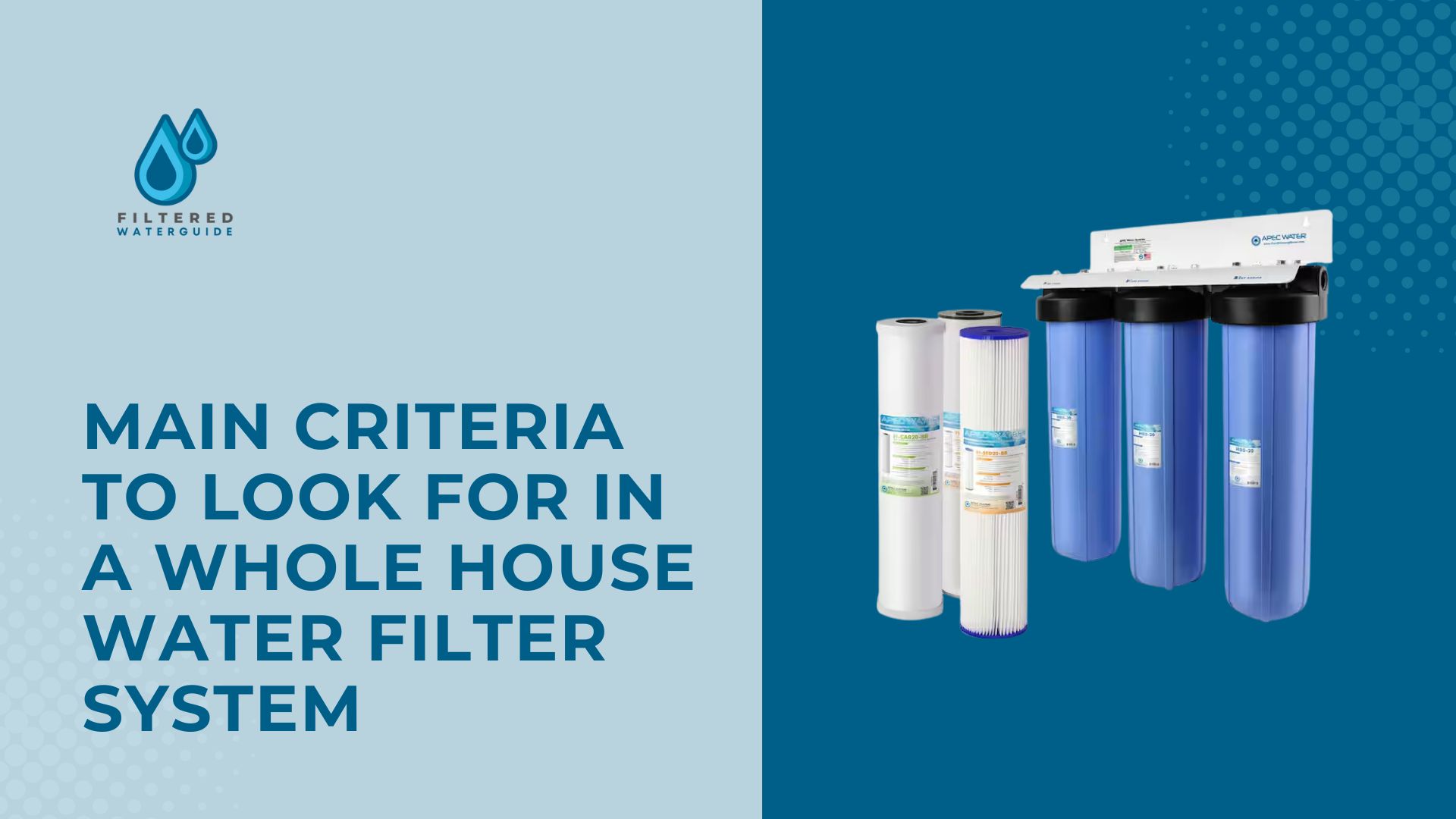
These are the five criteria we used to evaluate each whole home water filtration system, and they’re the main things that will determine if a system is right for your home.
The water filter type a whole house system uses is going to determine the contaminants it removes, and these are the most common filters used in whole house water filter systems:
| Filter Type | Contaminants Removed |
|---|---|
| Carbon block filter | Organic chemicals, foul tastes and odors |
| KDF filter | Heavy metals |
| Sediment filter | Silt, suspended particles, rust |
| Air injection oxidizing (AIO) filter | Iron, manganese, hydrogen sulfide |
The best whole-house water filter system is one that removes the contaminants particular to your water, and you may get a water testing kit to identify which pollutants are most prevalent in your supply.
If your water contains germs or viruses, get a UV filter attachment with your water filter purchase.
Another thing to look at is how long it takes before you need to replace filters in water systems.
This is known as the water filter life or filter longevity. This can be anywhere from 6 months for pre-and post-filters, to years for the main one.
Similarly, capacity refers to the number of gallons a filter can process over its lifespan. Ease of filter replacement and cost are other things to consider as well.
If you’ve ever tried to take a shower with a very poor flow, you know how frustrating it can be to have to wait on your water.
The water supply, or the water pressure, that comes out of house water filter systems is one of the biggest things that affects customer satisfaction with a particular system.
The National Sanitation Foundation (NSF) and the Water Quality Association (WQA) are two independent entities that certify water filters for water purification and other products for meeting standards like the reduction of specific contaminants or using parts of a certain quality.
Certification shows that brands put their money where their mouth is when it comes to claims about their products. See our guide to water treatment certifications here.
When looking at the whole house water filter systems, you have to take three factors into consideration to make sure it is cost-effective:
When shopping for a whole-house filtration system, keep in mind that it must be cost-effective and include the installation expenses as well as expected water filter replacements. These are the costs that most people overlook when purchasing.
We have used the criteria above to narrow down all the highly-rated whole house water filters. Out of all of them, these ten are the best for filtering water in your home.
Each one has specific qualities that make it stand out from the others, and each one provides high-quality filtered water for your needs.

Springwell’s CF1 model is our pick for the best whole house water filter and it’s also one of the best value whole house water filter system choices to improve your filter water quality.
The CF1 has consistently received stellar consumer reviews, and Springwell uses innovative 4-stage filtration technology in their water filter to go the extra mile to bring clean water to homeowners.
It’s also easy to install and low maintenance, and you can add a salt-free softening system if you would like.
Without altering water pressure or energy consumption, this house water filtration system treatment removes harmful contaminants such as PFOA, PFAS, and PFOS.
Springwell is an American-based company that backs its goods with an industry-leading 6-month money-back guarantee and a lifetime warranty, so you have nothing to lose.
This combination of cost-effectiveness and high-quality filtration in a whole house filter system is the main reason we love this water filter.
The SpringWell whole-house water filter system is great for people who want a high-quality filter to remove hazardous pollutants from their city tap water at an affordable price.
For more in-depth information, also see our complete Springwell Water Filtration Review.

The Evo Whole House Water Filter takes the silver medal for being the most effective whole-house water filter system with a large capacity for homes with up to 6 bathrooms.
It is an efficient cartridge-based whole house water filtration system particularly effective for treating city water. It utilizes a long-lasting sediment pre-filter and catalytic carbon block filter to remove a broad range of contaminants.
The Evo E-3000 is optimal for both municipal water and well water and effectively removes a variety of contaminants. This system shines with its two-stage filtration process that includes a sediment pre-filter and a catalytic carbon block filter, enabling it to clear hundreds of pollutants from your water.
The lifespan and capacity of this unit are substantial, providing filtration for up to 80,000 gallons of water.
Constructed in the USA, this filter system offers a lifetime limited warranty and is touted for its easy installation process.
The Evo Whole House Filter is ideal for those seeking an effective solution for removing chlorine and chloramine from their city water, especially those with a smaller upfront budget. It is not recommended for individuals looking to remove fluoride from their tap water; a reverse osmosis system would be a better choice in such cases.
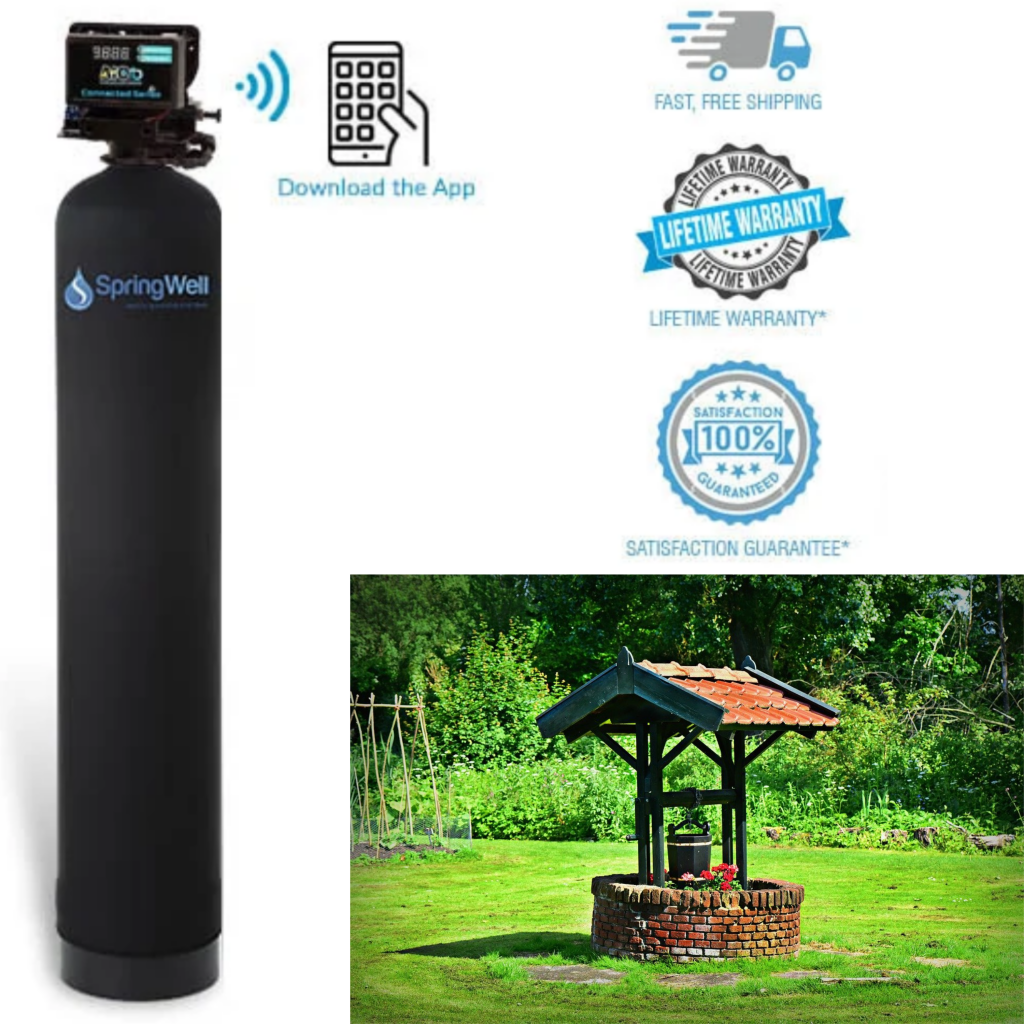
Springwell’s WS1 Filter System is our top solution for pure water from private wells.
If you’re someone who has determined you have iron, manganese, or hydrogen sulfide in your well water supply this is one of the top models on the market for you.
This unit features a 4-step air injection oxidizing filter system which works by oxidizing iron, manganese, and sulfur from your water and then filtering it out in subsequent stages of the process.
The filter system also requires no maintenance and causes no drop in water pressure keeping the flow around 12-20 GPM while other whole house water filters are usually in the range of 6-7 GPM.
To top it off, Springwell is a well-known American company that makes high-quality water filters with a 6-month warranty and an excellent money-back guarantee for its most expensive model.
If you have well water and want to see our specific review for this issue, check out our best whole house water filters for a well water guide.
If you have a home with a private well, then this Springwell whole-house water filter is a great choice.
You can also check out our review of Springwell’s WS models for well water here.

Suitable for both municipal water supply contaminants and hard water minerals, the Aquasana Rhino EQ-1000 is a 3-stage whole house water filter system combined with a salt-free softener.
The Rhino has been one of the most popular whole-house water filters for a while now because of Aquasana’s high-quality water filter technology and the ability to customize the models to your exact specification.
The Rhino comes in 600,000 gallons of water and a 1,000,000-gallon capacity model with a decent flow rating of 7 GPM.
One of the best features of these water filters is that Aquasana has gone through independent testing to certify that it removes 97% of chlorine as well as reduces lead, mercury, herbicides, pesticides, and VOCs.
With a price tag of around $1700, the ability to add a water softener and UV (or ultraviolet) light filter, and a highly trusted brand, you can see why the Rhino is one of the best picks.
The Aquasana whole-house water filter is a great choice for customers who are looking for a three-stage water filter system that also serves as a whole-house water softener.
It’s a great option for individuals who are concerned about chlorine, heavy metals, or other pollutants in their water and want the freedom to construct their own solution.
For more information, you can also see our complete Aquasana EQ-1000 Review or our Aquasana reviews page.

The SoftPro Carbon Filter is another good whole home water filtration system that competes with our top picks.
The main filter in this system is a catalytic back-washing activated carbon filter which is a type of processed activated carbon that removes 99% of chloramines, chlorine, VOCs, and other chemicals.
Besides the catalytic carbon filter, it also has a KDF sponge made from copper and zinc which helps remove heavy metals as well as a 5-micron sediment pre-filter to help remove sand and sediment before going through the main filtration process.
Another benefit of this system is that it includes an automatic backwashing system that operates without using chemicals or salt.
The filter has a capacity of 600,000 or 1,000,000 gallon options and usually lasts for around 5 years.
Overall, it’s a decent whole-home filtration system for someone looking for a lower-cost option to remove chlorine and chloramines.
For someone on municipal water who wants to save money while also eliminating chlorine and chloramines, as well as other contaminants, the SoftPro Carbon whole house water filter system is an excellent alternative.
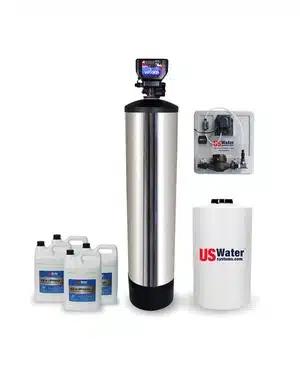
Introducing the US Water Systems Matrixx Infusion Iron and Sulfur Removal System, the ultimate solution for tackling iron and sulfur issues in well water. With its exceptional filtration capabilities, this system effectively removes 20 PPM of iron and 30 PPM of hydrogen sulfide, surpassing many other options on the market.
By employing chemical injection and oxidation processes across four stages, the Matrixx Infusion guarantees efficient removal of these contaminants, providing homeowners with clean, odor-free, and stain-free water.
Designed to cater to various flow rate requirements, the Matrixx Infusion offers options ranging from 10 GPM to 25 GPM, ensuring an adequate supply of treated water for households of different sizes. With a remarkable capacity of up to 1 million gallons, this system provides long-term filtration without compromising performance.
It is built to meet high-quality standards and is certified to ensure reliable contaminant removal.
Say goodbye to metallic tastes, staining, and unpleasant odors caused by iron and sulfur in well water. The US Water Systems Matrixx Infusion Iron and Sulfur Removal System is your reliable and trustworthy filtration solution, delivering exceptional results and providing the peace of mind that comes with clean, fresh-tasting water throughout your home.
The Matrixx Infusion Iron and Sulfur Removal System is ideal for individuals seeking to address iron and sulfur issues in their well water. Its superior performance in sulfur removal and effectiveness in iron removal make it a top choice for those prioritizing water quality. Please note that the system may not be as effective for individuals using well water with lower iron and sulfur levels.

The powerful Filtersmart FS1000 is ideal for homes with 1-3 bathrooms, delivering great flow while using activated coconut shell carbon media to remove a wide range of contaminants. If you have four to six bathrooms, they have a larger upgrade option as well.
Filtersmart is a newer firm in the water filtering industry, and while the FS1000 model isn’t anything special when compared to other similar models we’ve seen, it is well-built and affordably priced.
It has a similar flow rating at 12 GPM, comparable filtration capacity, and lacks certification.
The filter tank is composed of stainless steel, which is not only resistant to corrosion and high temperatures, but it does not break when dropped as plastic does.
Overall, it’s a good water filter at a low cost
This Filtersmart product is a great option to consider if you want a filter capacity that produces quality results without impacting flow.
You can also see our full Filtersmart reviews page here.

The iSpring WGB32B is a 3 stage filtration system that is good for any water supply. The base system uses a polypropylene sediment filter in addition to two carbon block filters to remove a large number of contaminants while maintaining flow and effectively reducing the taste of chlorine.
It removes agricultural and industrial solvents, chemicals, and VOCs or Volatile Organic Compounds.
One of the best things about this system is that you can customize it to your water’s needs and filter changes are easy.
If you’re on municipal water and chlorine is your biggest concern, you can stick with the 2 CTO filters. If you’re concerned about lead, you can replace one of the CTO filters with an ion-exchange lead reduction filter.
Similarly, if you’re on well water you can swap one of the CTO filters for a catalytic carbon filter media that reduces both iron and manganese and for increased filter capacity.
This unit is a good budget option to consider because it offers customization at a low cost and uses multiple sediment filters to get good results.
Overall, if you are looking for cheaper house water filtration systems, this is a model to take a look at.
This 3-stage filter is ideal for homeowners who want to clean up their home’s water supply on a budget. Choosing this iSpring whole house water filter means consumers can access a system with easy installation and a lower cost compared to most other models.
See our iSpring water systems review for more information about the company.

The Home Master HMF3SDGFEC whole house filter offers a flow capacity of up to 15 GPM. These water filtration systems work on both the top well contaminants and organic impurities.
Specifically, it removes up to 95% of iron, manganese, sediment, and chemicals.
At the low price tag of $500 and the ability to be a pretty effective well water filter, the Home Master is a good option to consider if you’re dealing with non-chlorinated well water.
The Home Master HMF3SDGFEC whole house water filters are an excellent choice for homes running on well water. However, if you’re looking for a whole house water filter for your city tap water, the HMF2SMGCC filters are worth considering as well.
See our Home Master review for more information about the company and our Home Master HMF3SDGFEC in-depth guide.

For homeowners who want a low-cost and hassle-free filter to improve their tap water, the 3M Aqua-Pure whole house water filter system is another unit to consider.
The 20 GPM water flow is suitable for households of any size, and the water filter is certified to improve the quality of your water.
It also features a scale inhibition system that protects pipes and appliances and its carbon filter captures sediment down to five microns reducing the taste of chlorine.
It has a 100,000-gallon capacity (which is very small) and it doesn’t remove heavy metals or chemical contaminants, but if you don’t need that capability, it’s a good value filter.
If you have city water that removes harmful pollutants effectively and just want to clean up the odor while also improving the taste of your water, this is an excellent filter for enhancing aesthetics.
| Product | Filter Type | Filter Capacity | Flow Rate | Certifications | Price |
|---|---|---|---|---|---|
| SpringWell CF1 | Catalytic Carbon, KDF-55 | 1,000,000 | 9 GPM | N/A | $$ |
| AquaOx | Catalytic and Activated Carbon, KDF-55 and -85 | 2,000,000 | 15 GPM | NSF & WQA | $$$$ |
| Springwell WS1 | AIO | 2,000,000 | 12 GPM | N/A | $$$ |
| Aquasana Rhino EQ-1000 | Activated Carbon, KDF-55 | 1,000,000 | 7 GPM | NSF | $$$ |
| Pelican PC600 | Activated Carbon, KDF-55 | 600,000 | 8 GPM | NSF | $$ |
In our guide below you can learn everything you need to know about whole-home filters to make the best decision based on your home water needs.
A whole house water filter is a filter that treats all the incoming water that enters your home through its main water line.
This means that all the water in your home including sinks, showers, kitchen appliances, bathtubs, and any other water outlet will produce filtered water.
Whole house water filters are considered point of entry water filters because they filter water at your home’s main entry line.
There are a number of different types of whole house water filters which focus on filtering different contaminants based on the type of filter media they contain.

A whole house water filter system attaches to your main water line’s point of entry.
When the water from your city or well supply runs into your incoming home water line the water passes through a filter or a set of filters before reaching appliances, faucets, and other water-using fixtures throughout your home.
This ensures that all the incoming water is filtered using the media in your whole home filtration system.
For a more detailed explanation check out our how do whole house water filters work page.
There are many different types of whole house water filters and they each remove different contaminants depending on what filter media they contain. The best systems will remove a wide variety of the most common water contaminants.
The main contaminants found in city water supplies:

The main contaminants found in well water:
Other potential contaminants in both (but more likely found in well water):
In order to find out what contaminants are in your water specifically, you should educate yourself on water testing and purchase a water testing kit that will break down the types and amounts of each contaminant.
That way you can target your whole-house filter purchase to the one that will best meet your needs.
Most of our top models above will filter out a wide range of water contaminants for both city and well water.
There are several reasons to invest in a whole house water filtration system, from health benefits to improving the lifespan of your appliances.
The main reason homeowners decide to purchase whole house water filters is to keep their family members safe from illnesses associated with different contaminants like lead, pesticides, industrial run-off, bacteria, and more.
It’s not uncommon to find reports of excessive amounts of harmful chemicals in a city’s water supply.
Cleaner water is also essential for your appliances. If the system has a filter that removes sediment, less sediment means less damage to the parts of your washing machine, water heater, dishwasher, etc.

Do you ever notice that your clothes come out of the washing machine looking less clean than they started?
White garments are particularly susceptible to stains due to dirty water.
You could fit a filter just on your kitchen faucet, but this would only provide you with clean drinking water – you’ll still be showering and washing dishes with contaminated water.
Adding individual filters to all your appliances and faucets could be an alternative, but this would be more expensive than installing one whole house filtration system.
By installing a whole home water filter instead of using bottled water you are also helping the environment since the use of plastic plays a role in harming our oceans and ecosystems. Not to mention it’s also a hassle to constantly purchase and store bottled water containers.
See a full list of whole house water filter benefits here.
There are significant differences between whole-house water filters, and when choosing the right one for you it’s necessary to think about your water quality issues and home specifications.
If you conducted a water test to determine which contaminants are in your water supply you will first need to find a home filter cartridge that removes the contaminants your water contains. Then you will need to make sure that the filter size, capacity, maintenance needs, and price fit your household.
See our cost breakdown guide here.
Depending on your home setup you may also need to look at factors like the dimensions of the system, the ease of installation and filter replacement, and the size of the inlet piping.
Make sure the specs match your home size and water issue and find the best price that fits those needs.
Think about what kind of whole house water filter would suit your needs. For instance, if your water source is well water that contains high quantities of iron, you’ll need to choose a filter system that removes iron.
If you have hard water as well as contaminants, you may need the best whole-house water filter and softener combo in one unit like Aquasana’s Rhino.
If your water contains bacteria or viruses, opt to include a UV filter attachment with your purchase.
The goal is to match the correct types of filters to your water contaminant needs.
You need to determine the right size for the filtration system.
Large systems tend to offer a greater water flow, which is always beneficial for large houses. However, small homes and condos rarely require the same high flow – and it’s usually challenging to find space to fit a larger filtration system so it’s best to find a unit that fits those requirements.
One additional consideration that may change how you want to set up your home’s filtration is the micron rating.
The micron rating tells you what size particles are filtered out of the water.
For instance, a portable water filter for hiking and camping has low micron ratings – down to as small as 0.1 microns. That’s because they need to remove tiny particles that could be dangerous to your health like microbial cysts.
In contrast, whole-house systems may only need a 5-micron filter. The exception is when the particles in your water are tiny, in which case you may need as low as 1 micron instead of 5 microns.
However, if you choose anything lower than this, your water flow pressure will drop considerably.
Suppose you require a tiny micron rating due to the incoming water’s low quality, but you’d rather not sacrifice your flow capacity.
In that case, a solution could be to purchase a standard whole house water filter and install an additional point-of-use filter where water needs to be extra clean – such as the kitchen sink.
That will keep the flow high enough to meet your needs on appliances like the washing machine and shower while still providing the cleanest drinking water at your kitchen tap.
If you need more help choosing your filter we created a step-by-step guide to choosing a whole home filter.
You may be asking yourself if installing and maintaining a whole house water filter is going to be a pain in the butt.
Basically, if you have some amount of plumbing or handyman experience working on your house then you should totally be able to install a new home filtering system without any issues. Most of the time the manufacturers include detailed instruction guides in the purchased kit and it’s not too complicated to set up.
On the other hand, if you have very little experience with handyman tasks then we definitely advise you to call a plumber to install your system. You don’t want to screw up your water line if you have no idea what you’re doing.
We go into detail on our whole home filter installation guide here.
In terms of maintenance with whole home filters, they really don’t take much time or effort to maintain besides a few routine tasks. Below are the basic steps to maintaining a home filter system:
Check out our whole house filter maintenance guide to learn more.
While most whole house filters efficiently provide filtered water to your whole home, reverse osmosis filters are very inefficient and generate a lot of wastewater when used to filter a whole home.
Instead, reverse osmosis systems are most often used at individual faucets or fixtures for clean drinking water.
The reason reverse osmosis systems are popular is because of their effectiveness. They remove the most amount of contaminants from water including healthy metals, bacteria, chemicals, and most of the impurities whole house systems remove but the downside is they create a lot of waste and are very inefficient.
A good option to consider for the most complete water treatment solution in a home with very poor water quality is using a whole house filter on the point of entry and a reverse osmosis filter under your sink for drinking water.
Just make sure to pick a reverse osmosis system that adds back in healthy minerals if you want that benefit.
Water softeners are point-of-entry systems that remove total dissolved solids (TDS) from the water like calcium and magnesium, which prevents scale buildup.
Most regular filters (including whole home) don’t remove TDS or minerals like calcium and magnesium, while most softener systems don’t remove heavy metals, chlorine, and other contaminants that whole home filters do.
Many people install both a water softener and a whole-home filter in one unit to take care of both contaminants and hard water minerals if their water quality is poor and some people decide to purchase one or the other or even both individual units.
When other homeowners are looking for the best whole house water filter, these are the main questions that they’ve been asking.
A: If you get your water from a well, then you definitely need a whole house filtration system. While your city’s municipal water supplies should meet set standards for health and purity, you may want to remove some particles like fluoride or chlorine that remain, even though they’re at safe levels.
If you get your water tested and you find that there are no contaminants over recommended levels, then you may not need a whole house filter.
Likewise, if you’re only interested in increasing the quality of your drinking and cooking water, you can use a point-of-use filter on your kitchen faucet.
See our guide on determining if you need a whole house water filter for more information.
A: Yes, we believe they are. What’s the price tag for peace of mind? What’s the value of your family’s health? More tangibly, you’ll see real dollar savings since your appliances will have extended lifespans.
If you’re someone who thinks they want to create a DIY whole-house water filter to save a few dollars then make sure you are ready to deal with the hassles that come with that process.
Yes! Better quality drinking water is one of the main benefits of whole house filtration systems.
Yes, you will likely need to replace your water filters after a certain period of time depending on the brand of filter your purchase. Usually, whole home filters last a long amount of time (years) before needing to replace the filter cartridges.
You can see our best whole house water filter cartridge page here for replacements when needed.
As long as you purchase a high-quality filter they usually don’t require too much maintenance. If the filter has any malfunctions we usually hear people reporting about issues like leaking problems, the filter getting stuck, backwashing problems, or a pressure drop that needs to be fixed.
A whole house filter filters all the incoming water to your house (including all faucets) while an under sink filter just filters water under you kitchen sink at one point of use. See our under sink vs whole home filter guide for more information.
Yes, you can disconnect your filter or create a bypass temporarily to turn off the filtration system when it’s not needed.
If you want the best whole-house filter system for city tap water at an affordable price, go with the SpringWell CF1 model.
If you are looking for the highest quality and largest capacity and aren’t concerned with price, go with AquaOx.
Lastly, keep in mind that a whole house filter is an investment in quality filtered water that can last you for a long time and keep your family safe, healthy, and clean.
So we recommend weighing the pros and cons before choosing one of our top picks and not skimping out on this purchase.

David is an expert in all things plumbing, heating, cooling, and water treatment. He got his start in the plumbing business working on fixing all types of home improvement issues including water leaks, broken toilets, appliance installation, and more. Over time, he learned a ton about installing and choosing the correct water treatment products for homeowners.
15657 N Hayden Rd #1162
Scottsdale, AZ 85260
United States
602-780-2598
© Filtered Water Guide
Filtered Water Guide is a participant in the Amazon Services LLC Associates Program and other partner programs, which are affiliate advertising programs designed to provide a means for sites to earn advertising fees by referring users to merchant stores.