Filteredwaterguide.com is supported by readers. If you purchase through referral links on our site, we make a commission at no extra cost to you. Learn more.
Home » Water Filtration Systems » 8 Best Whole House Water Filters for Well Water in 2023
If you use a private well as your drinking water source, you’re probably aware that you might be exposed to a few hazardous contaminants.
When it comes to water filter media, private well owners are on their own for their water supply when compared with residents of public water systems or city water.
The best whole house water filter for well water is the one that removes contaminants specific to your region because you and your home will have distinct demands.
Having said that, let’s get to our list of the top well water filters that can help you attain the purest water quality possible.






These are the main factors and criteria that will affect how well a whole-house well filtration system is going to work:
Well water often contains harmful contaminants, sediment, minerals, heavy metals, chemicals, and even microorganisms and radionuclides depending on where you live and how your well’s water is sourced.
Three of the most common contaminants are iron, manganese, and hydrogen sulfide, but you can find home water testing kits that will tell you exactly what impurities and total dissolved solids are in your well.
The contaminants your well water filter is going to be able to remove depend primarily on the filter media it uses, and these are the most common filters used in well water filtration systems:
| Filter Type | Contaminants Removed |
|---|---|
| Air injection oxidizing (AIO) filter | Iron, manganese, hydrogen sulfide |
| KDF filter | Heavy metals |
| Carbon block filter | Organic chemicals, foul tastes and odors |
| Sediment filter | Silt, suspended particles, rust |
| UV filter | Bacteria, viruses, protozoa |
Multiple house water filters on our list are going to come with the ability to upgrade or add other components, which means you can tailor these filter media systems to your home’s specific water quality needs.
For example, many whole house water filters will let you add a UV light stage to the process, which offers extra protection against microorganisms. Others will let you add a water softener if you live in an area with very hard water.
This is a measure of your water’s pressure and is usually notated in gallons per minute (GPM).
Most water filters are going to have at least some impact on flow volume, and if it drops too low you might not have enough pressure to shower, do laundry, wash dishes, etc. without hassle. Make sure your well water filtration system is going to meet your home’s GPM needs.
Whole house filtration systems for well water are an investment, so you want to get a system with good longevity that also isn’t going to be too hard to maintain. Most systems are rated for a specific number of gallons, which roughly translates into the years you can expect it to last. For example, a 500,000-gallon filter will last around five years.
As for maintenance, if you get a water filter for a well that also has a built-in water softener, you’re likely going to have more maintenance than you would with a regular filter. Likewise, most carbon and sediment filters will need to be replaced every 6-8 months, so knowing ahead of time what maintenance your filtration system will require will help you plan accordingly.
The two main independent non-profits that certify water filters are the NSF and the WQA. Their labs test manufacturers’ claims about their products and certify them for the standards they meet the criteria for.
Common well water filtration system standards are the NSF P231 for microorganism removal, the NSF/ANSI 42 for aesthetic taste and smell, the NSF/ANSI 53 for the removal of contaminants with health effects, and the WQA Gold Seal certification for materials safety, contaminant reduction, and business integrity.
Price is almost always going to be a factor in your purchasing decision, but the initial cost may not always reflect what you’re going to pay for a whole house water filtration system.
You also have to factor in the costs of replacement filters in multiple filtration stages and other maintenance as well as the added water expense from systems that require backwashing.
After conducting extensive research and using the criteria above, we created this review of the top 8 whole house water filtration systems for well water.


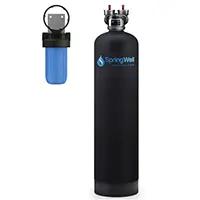
Our top choice for the best whole house water filters for well water is this WS system from Springwell.
Using AIO technology, this filtration system is extremely effective at removing the top three well contaminants: iron, manganese, and hydrogen sulfide – and it does it all without hurting your water supply flow volume.
The system is also equipped with Bluetooth programming and it comes with a DIY-friendly installation kit plus a lifetime warranty from one of the best companies around.
Between the filtration capacity and the 12 GPM flow volume, the value of this whole house water filtration system is readily apparent. Throw in the Bluetooth interface and the lifetime warranty, and it’s easy to see why this model tops almost every well water filtration system review out there.

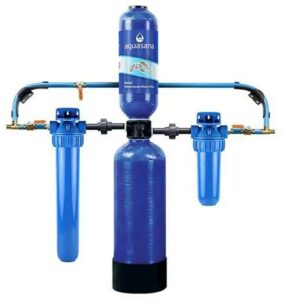
The runner-up for the best whole house water filter is this carbon well water filtration system from Aquasana.
Rather than AIO, this system uses a carbon block filter as well as copper-zinc and mineral stone to purify your water – and the result is water that tastes better, smells better, and is all-around better for you.
The best feature about this whole house filtration system is that it gives you the option to modify your system by adding a UV purifier or water softener in addition to the carbon-based whole house water filter.
This filter is a great option for those who want fantastic contamination reduction at a good price. The KDF-55 and activated carbon filters combine to remove more impurities than just an AIO sediment filter alone but keep in mind that if you have a large home and/or heavy water usage, the flow volume may be a little low. Also, if you don’t mind a little extra upkeep for the pre-and post-filters, then your water quality will reflect it.
Between the built-in UV light and the multi-stage filtration, this product is a great option to consider – as long as you’re willing to trade a little bit of water pressure and a few minutes of your time every couple of months.

Taking home the Bronze is this Pelican 4-stage whole house water filter. It has been both NSF and WQA certified, and it incorporates both activated carbon filtration and a powerful iron sediment filter.
It uses a 4 stage system to filter out sediment and remove iron up to 10 ppm while maintaining a flow volume of 10 GPM. It also comes complete and ready to easily install.
If your well water comes with crazy amounts of iron, then this water filter is the one for you. Also, if you have a large number of microorganisms in your water then this house well water filter system is great for killing bacteria, protozoa, etc. For those who want to ditch the red water rings without losing water pressure, you’ll love this Pelican product.
This well water filter system is a miniature water treatment plant – and you get all the benefits for your home. It’s also one of the priciest house water filter systems on the list, but it’s well worth the anti-iron and antimicrobial effects.
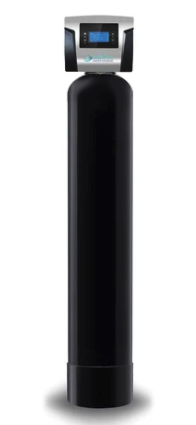
The SoftPro Iron Master is an efficient high-quality iron sediment filter for well water.
They don’t call it the Iron Master for anything – these filter cartridges remove iron, manganese, and hydrogen sulfide at levels higher than almost any other filter on the market with its AIO technology.
It comes with a lifetime warranty on the control valve and tank plus it’s very reasonably priced compared to other brands.
If you want exceptional whole house water filtration of iron, and manganese at a great price – and your house can accommodate the 6 GPM flow – then this is the system for you.
If you don’t want the hassle of managing replacement filters and doing other upkeep, then that also makes this a good option.
For a smaller household with an iron problem, this is one of the best house water filter systems you can get. No extra filters mean no maintenance, but it also means no extra filtration. If you have other contaminants in your water that you want to remove besides the big three, then you should consider getting a sediment pre-filter or carbon post-filter.
With this house filter system from Home Master, you get 3-stage filtration that removes a wide range of contaminants – all while maintaining excellent flow.
The triple whole house sediment filter system removes 95% of sediment and chemicals, plus iron, sulfur, and manganese up to 3 ppm.
This well water filter system also contains extra-large filter cartridges for durability and it offers up to 15 GPM in water flow.
It comes with a 2-year warranty and everything you need to DIY install pretty easily.
If you don’t mind a bit of extra maintenance and would rather spread out the costs yearly instead of paying more upfront, then you should consider this well whole house water filtration system. The flow volume is also great for larger households, and you’re still getting high-quality filtration.
The iron filtration capacity isn’t as high as some of the other models, but if your water tests for under 3ppm then the wide range of other contaminants removed makes this filter a good contender. The high flow volume also can’t be overstated.

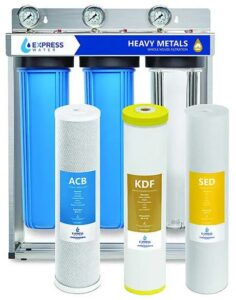
Up next is this 3-stage system from Express.
Combined sediment, KDF, and carbon block filters take out the majority of a wide range of contaminants, and this product has over 93% 4- and 5-star reviews.
This unit has a high flow rate capability so you won’t need to worry about your water flow but the filters only last for 100,000 gallons or 1-year which makes them not quite as durable as other top house water filter systems we’ve reviewed.
If you want a reliable water filter system with excellent flow and the ability to spread out the costs, then this may be the well water filter for you. Without knowing the exact specifications for iron removal, however, it may be better to look at other systems if your water tests for over 2-3ppm.
This whole house filter is very similar to the Home Master in its filtration capabilities, flow, and maintenance required. You’ll save a bit more money on this well water system but you’ll lose a year of warranty, and there are no extra upgrades or features with this model. Even so, it’s still a great option for those who want clean water on a budget.

While this whole house water filter isn’t designed specifically for well water, it can still remove a wide range of contaminants using polypropylene and activated carbon filters.
It removes 99% of chlorine, 95% of sediment including rust, and other chemicals like herbicides, pesticides, VOCs, and industrial solvents.
This whole house water filtration system can be used for homes with municipal city water, and well water sources.
If your well water has minimal heavy metal impurities but still comes out foul-smelling and tasting, then this is the perfect filtration system for you. You’ll see immediate improvements in your tap water quality without any detriment to flow, and all for a relatively low price.
If you need to filter out iron, manganese, hydrogen sulfide, and other heavy metal contaminants, then this isn’t the system for you. But if your drinking water needs improvement and chemical reduction, then this is a great option for the price and you can customize it with upgrades and add-ons to meet your home’s other needs.
Our final contender in the whole house filtration system is this HD200 system from Culligan.
This all-in-one well water filtration system is compact and streamlined, and you have several different options for the filter cartridge so that you can choose the one that best fits your home.
The main focus of this whole house filter is its ability to remove sediments such as dirt, sand, rust, and silt from 1-50 microns.
For those who want to spend as little as possible on their whole-house filter, this is as good as it gets. Who doesn’t want their water to be clear? If you have light-colored and fairly tasty drinking H2O, then this is an excellent choice for sure!
You probably don’t want to change the water pressure flow rate if you have a larger household, but with the different filter options available you can tailor this filtration media system to your needs.
This system isn’t going to work quite as well as some of the others at removing chemicals and other This house well water system isn’t going to work quite as well as some of the others at removing chemicals and other impurities, and you definitely want to look at another filter for heavy metals. Having said that, it’s a great, low-cost option to aesthetically improve the drinking water of those who can afford a hit on their flow rate.
| Product | Contaminants Removed | Upgrades | Flow Rate | Filter Lifespan | Certifications | Price |
|---|---|---|---|---|---|---|
| iSpring 3-Stage Filter | Sediments, organic chemicals | UV filter, water softener | 15 GPM | 1 year | N/A | $$ |
| Culligan WH-HD-200-C | Sediments, organic chemicals | Filter choice | 3-10 GPM | 2 years | NSF/ANSI | $ |
| Aquasana Well Water Rhino | Heavy metals, organic chemicals, sediments | UV filter, water softener, install kit | 7 GPM | 5 years | NSF/ANSI | $$$ |
| Express Water Heavy Metal Filter | Heavy metals, organic chemicals, sediments | N/A | 15 GPM | 1 year | NSF/ANSI | $$ |
| Home Master HMF3SDGFEC | Fe, Mn, organic chemicals, sediments | Pressure gauges | 15 GPM | 2 years | NSF/ANSI | $$ |
| SpringWell Well Filter | Fe, Mn, H2S, sediments | UV filter | 12 GPM | Lifetime | N/A | $$$$ |
| Pelican Iron & Manganese Filter | Fe, Mn, H2S, organic chemicals, sediments | Water softener | 10 GPM | 5 years | NSF/ANSI, WQA | $$$$$ |
| SoftPro Iron Master | Fe, Mn, H2S | UV filter, water softener, install kit | 6 GPM | 5-10 years | NSF/ANSI, IAMPO, ISO | $$$ |
Before you can select the best home water filter system for well water, you need to know more about them and well water in general.
You can also see our full guide to well water treatment here.
A water filtering system for well water consists of filters mounted on water lines at entrances to a house. They vary in size, type, and filter techniques according to the contaminants they focus on.
Well water filters focus on filtering out contaminants that are typically found in groundwater such as iron, manganese, hydrogen sulfide, and others.
By working at the incoming water supply line, the contaminants are filtered out before they are allowed to enter your home.
Below is an example of what a well water filter with water softener looks like:

Well water is a grab bag – there could be just about anything in there depending on where you’re located.
This is because well water is not treated like your city water supply which runs through a treatment plant.
Some of these contaminants are only annoying. They cause mineral stains, make your water smell or taste funky (like sulfur), but don’t pose any real health threat.
Other contaminants have significant risks, even in microscopic amounts (think arsenic).
Filtering out these harmful contaminants is why a well water filter is essential.
Unless you have exceptionally pure water that is free of harmful contaminants, well water filtration systems are an investment in your health as well as a way to make your water look, taste, and smell better.
As mentioned, iron, manganese, and hydrogen sulfide are the three main contaminants you’re most likely to find, but you could also have any combination of arsenic, chromium 6, mercury, lead, nitrates, VOCs, brown residue, sediment, inorganic chemicals, minerals, radon, coliform bacteria and many other harmful contaminants in your water as well.
It all depends on what’s in the ground around you, and what’s contributing to the water below.
Whole house well water filtration systems are installed at your home’s water point of entry where all the water comes into your home through the main pipe.
The water flowing into your home from the well will then have to pass through the water filter that was installed where it contains a certain type of filtration technology either using standard sediment and carbon filters, KDF media, mechanical filtration, or technology designed specifically for well contaminants like air injection oxidation.
Sometimes whole house water filters also contain an optional UV purifier that uses ultraviolet light to remove microorganisms in your water supply.

There are five main methods deployed to purify well water, and water filtration systems may incorporate one or a combination of the following: air injection oxidization, KDF, activated carbon, UV light, and mechanical filtration.
Air injection (AIO) uses a pump to inject air into the water, which oxidizes iron, manganese, and hydrogen sulfide. The oxidized metals are not water-soluble and are trapped by the media in the tank. These filter systems work on iron consistently, but with manganese and hydrogen sulfide they will only work if your water is at a high enough pH. Some systems incorporate pH correction to counteract this.
As more and more oxidized metals become trapped, the media gets clogged and must backwash – or flush out – the built-up debris. This generates a bit of wastewater, but not as much as some other filtration types.

KDF is a combination of copper and zinc that causes the transfer of electrons between that media and the other elements it contacts. This causes soluble heavy metals like copper, lead, mercury, iron, and others to become oxidized and precipitate out of your water, along with other water contaminants like chlorine.
It’s also bacteriostatic, which means it prevents the growth of bacteria and other microorganisms. Like the AIO filter, it uses a backwash feature to clear away the filtered debris.
Activated carbon, or charcoal, is processed so that each particle has millions of pores that serve to trap impurities in water. As water flows around the carbon particles, suspended solids, sediments, chlorine, VOCs, and other organic water contaminants like pharmaceuticals, pesticides, and herbicides are attracted to the carbon media and stick to it. Other particles that are larger than the pore and channel sizes become trapped as well.
While technically not a filter because nothing is removed, UV light kills microorganisms like bacteria, viruses, and protozoa instead by damaging them with ionizing radiation. The intensity of the light source corresponds to its effectiveness, and UV light systems have the potential to kill over 99.9% of microorganisms in your drinking water.
The most simple filtration method involves simply taking a barrier and making small holes in it that the water can pass through but anything larger than the pore size cannot. Mechanical filters are rated by the size of their pores, and the most common well water filters are 5-micron – meaning they block any contaminants that are larger than 5 microns.
AIO and KDF are the two best water filters for removing iron, and KDF has the added benefit of being inhibitory to iron-loving bacteria as well.
Just make sure you know the ppm of iron in your water so that you can find an AIO or KDF iron filter with a high enough capacity.
Iron is a harmful contaminant at high doses so make sure to get a water test for iron if you think you are experiencing iron issues.
Coliform bacteria are bacteria that are found naturally in the environment as well as in the intestinal tracts of mammals. They’re common water contaminants, but high numbers can cause significant health problems, especially in immunocompromised individuals.
Chlorine and UV light are commonly-used disinfectants that kill the bacteria in your water, while gravity-fed filters and reverse osmosis filters will remove them completely.
See our review of the best water filters for coliform bacteria for more specific information.
While traditional water softeners are technically filters because they remove minerals that cause hard water like calcium and magnesium (which are total dissolved solids, or TDS), water softeners are mainly used for aesthetic purposes. A house well water filter on the other hand generally doesn’t remove TDS and works on a wider range of water contaminants to improve the water quality.
You can’t get a well water filtration system until you know what’s in your well water, or the water quality because the best house well water filter in the world is going to be useless to you if it doesn’t take out the contaminants that are in your water specifically.
You can purchase testing kits that will give you a breakdown of what metals, minerals, chemicals, and other contaminants are present so that you can find the well water filtration system that will work the best for them.
For example, a high-powered iron filter would be useless to you if your well water isn’t high in iron, whereas a carbon filter won’t do you much good if your well is only full of metals.
Another thing to consider is where you’re going to put your well water filter. You’ll want house filters somewhere you can easily access for maintenance and to change settings, and they should also be installed in line with your main water line. Make sure the well water filter system you select will be able to fit where you want to install it.
Most well water systems are going to be rated for 1-3 bathrooms or 4-6, which will give you an idea right off the bat of the size you need. Refining that further, the flow rate will also tell you how large of a house a filter can service.
Every appliance and fixture that uses water is going to need flow, and these are the average flow requirements for each appliance:
| Appliance | Flow Rate (GPM) |
|---|---|
| Bathroom Faucet | 0.5 GPM |
| Kitchen Faucet | 0.5 GPM |
| Shower | 2.5 GPM |
| Dishwasher | 1.0 GPM |
| Clothes Washer | 1.5 GPM |
In order to know what size filter you need in terms of flow rate, calculate the flow you would need if you run all of your water-using appliances and fixtures at once without losing water pressure. That’s the maximum amount of flow you need, so any filter with a flow rate over that is more than enough for your house.
As with most things, how easy it is to install and maintain your water filter is going to depend on which system you choose. Some may need to be installed by a professional plumber, either by necessity or because not doing so will void the manufacturer’s warranty. Other systems come with DIY installation instructions and kits to make it easier to do on your own.
Similarly, a carbon filter, iron filter, or sediment filter is going to need more frequent maintenance and replacement than those with KDF or AIO media alone.
To protect the consumer, all municipal water goes through a variety of treatment processes. Most private wells are not covered by this statement. This is why well water usually contains a variety of hazardous pollutants that influence water odor and taste.
You are solely responsible for ensuring that the water you and your family consume on a daily basis is safe and nutritious which is why you need a whole house water filter. Furthermore, clean well water does not harm appliances such as water heaters and has a longer service life.
Well water contamination is a big problem in many parts of the world. It can come from natural sources, but it’s also possible that man-made chemicals have been put into drinking supplies. Below are a few main culprits:
The best way to determine what contaminants are in your well water is to get it professionally tested with a lab or a high-quality water test kit.
Well water does not get treated. If you do not check the well water regularly, then you can end up using toxic chemicals and microbiological contaminants that cause a lot of discomfort to your body.
Most of the time well water filtration systems will not remove bacteria unless they contain an added UV filter on the unit.
This is because whole-house filters for a well filter system focus on removing iron, sulfur, manganese, and other chemicals that are usually in high amounts in well water to improve water quality, but these types of filters they use do not kill bacteria.
If you have a high amount of microorganisms in your well water then consider adding on or installing a UV purification system to your well filter in order to improve water quality.
It depends on the contaminants in your well water and the water quality. A system using air injection technology focuses more on removing iron, sulfur, and manganese while a system using filters is more typically used for municipal city water supplies where it removes a broader range of contaminants.
A standard well water filter requires more maintenance because you will have to replace the filters while a system with air injection oxidation requires little maintenance and works great on well contaminants.
It depends on the whole house water filter you purchase. Some whole house filters are designed to be installed outdoors while others should be kept inside during winter weather to maintain function.
Keep in mind that most whole house water filtration systems are designed to be installed at the water point of entry of your home.
Most of the time you will need an additional water softening unit to improve well water quality because most water filter systems are not designed to reduce scale and hardness causing minerals.
Check out one of the sediment filters for well water we reviewed that have the option to add on a softener or come with a softening device already.
Yes, the reverse osmosis system is an effective filter to improve well water quality. The only downside to reverse osmosis units is they are not as efficient as the whole house well water filters.
Most RO systems are the point of use devices meaning they are installed under the sink and only provide filtered water to one point in your home. On the other hand, the filter for well water we reviewed provides filtered water to your whole house.
A well water filter is important for the health and aesthetics of your water. The Springwell Well Filter System is our choice for the best whole house water filter for well water due to its great flow rate and fantastic filtration of iron, manganese, and hydrogen sulfide.
In order to make sure this well water filter system is best for you, you should have your well water professionally tested to see what contaminants it contains and measure your household’s flow requirements.

15657 N Hayden Rd #1162
Scottsdale, AZ 85260
United States
602-780-2598
© Filtered Water Guide
Filtered Water Guide is a participant in the Amazon Services LLC Associates Program and other partner programs, which are affiliate advertising programs designed to provide a means for sites to earn advertising fees by referring users to merchant stores.