Filteredwaterguide.com is supported by readers. If you purchase through referral links on our site, we make a commission at no extra cost to you. Learn more.
Home » Water Softeners » 6 Best Water Softeners for Well Water Reviewed
If you have a private well and experience hard water you know how much of a pain in the ass this can be.
Luckily, there are many water softener systems on the market that can help make life a little easier
.
In this post, we’ll review six of the best water softeners for well water.
I have over 26 years of treating swimming pool water for hard water problems that resulted from them being filled with well water, so I know how to tell the difference between a poor and high-quality water softener.
I will not only review with you the top well water softening choices but I will also give you some helpful water conditioner information and discuss some of the questions regarding the best water softener systems that I get asked about the most often.
Once you are finished reviewing, I am confident you will find the best water conditioner for well water that fits your needs.

Here are the main criteria I would evaluate water conditioners on if looking to purchase one for your well water:
You will come to find that there are several different methods water softeners use to treat hard water minerals. Some will be very appealing to you and others not so much.
The different water softening methods also have different levels of effectiveness and other features that set them apart from other brands of water softeners.
Find a water conditioner for well water and an iron filter that works in the most efficient way possible for your home water needs.
I believe that no drinking water that my family and I take into our bodies can ever be pure enough. That’s why it’s a nice bonus if the water softening device that you buy is also able to filter out other impurities in your tap water such as iron with an iron filter.
Not all water conditioner models strictly remove just hard water-causing particles. Some also have added features that will do such water purifying tasks as removing bacteria and filtering out other harmful contaminants that can impact you and your family’s health.
If you have contaminants in your water like iron, then it will be useful to make sure the water softener also contains an iron filter.
Many also come with add-ons that can be purchased that will deal with other well water contaminants too.
Some water softening devices can be wall-mounted out of the way while others take up large amounts of floor space so they need lots of room to be set up.
That means the amount of space that you have available to install a new water conditioner could play a role in which type of water softener you choose.
This is one of the most misunderstood traits of salt-based water conditioners but it’s also one of the most important to consider when shopping for one.
That’s because the bigger your household is in size the higher grain capacity you will need to have in your new water conditioner system for well water.
Water softeners not only come in all different types but they also can be purchased in many different price ranges. It’s important to determine what your budget is for buying and installing one of these systems before you start shopping for one.
This also has the added benefit of helping you narrow your choices down.
After conducting extensive research and using the criteria above, we created this review of the top 8 whole house water filtration systems for well water.

This is a water conditioner that’s made by the reputable water treatment company Springwell. It was an easy pick for my top model water conditioner because there is so much to like about it. It’s available in three different sizes too.
It all starts with the fact that this is a salt-based water softener. That means you will have purchased the top-performing type of water softening product that’s available when you buy it.
This dual-tank system complete with a brine tank and resin tank boasts an excellent flow rate from 11 to 20 GPM depending on which model you select. It can also be remotely operated by using its convenient Bluetooth control valve.
Additional water treatment options that can be purchased to work in conjunction with it include whole-house filtration equipment and a bacteria-altering UV light system.
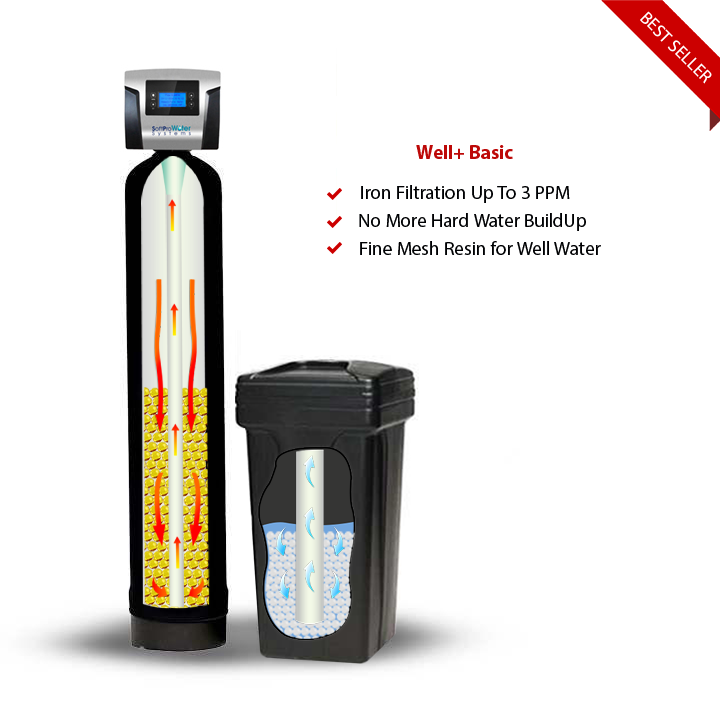
If you have a larger size home and are not interested in having much of a water pressure drop when you install a new water softener, then you should check out the SoftPro Elite’s largest size model which is one of the better ion exchange water softeners.
It’s a salt-based water softener that comes in all different grain capacities which start at 24,000 GPM and go all the way up to 80,000 GPM.
Those higher grain capacities that are offered allow these systems to let water pass through them at impressive flow rates. SoftPro’s stated flow rates with this design are up to more than 50% faster on average than with more traditional salt water conditioner designs.
This system is operated through the use of an advanced programmable backlit control head that even includes a precision brine-producing feature. Efficient salt use and a lower average price than most comparable systems on our list are also nice bonuses that you get with this model of ion exchange water softeners.
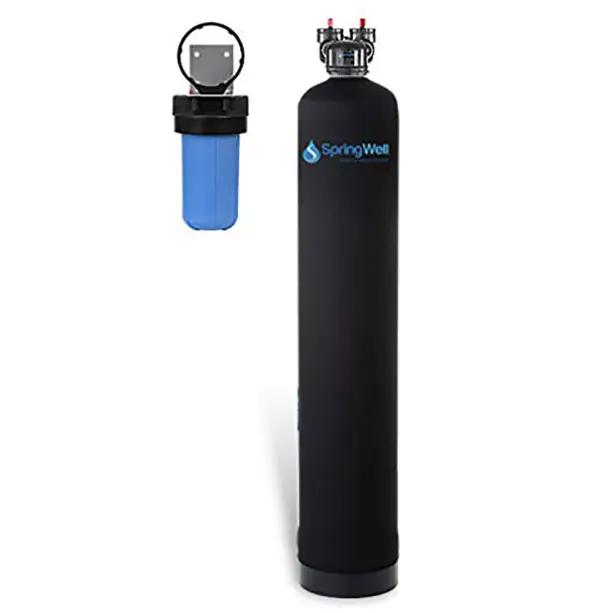
It’s very rare in any of my review articles that the same manufacturer has products that occupy multiple spots on a best-of list. That’s exactly what happened here thanks to this being another highly rated SpringWell softened water product.
Unlike its sister water softener above, this model is what’s known as a salt-free water treatment system. It uses what is known as Template Assisted Crystallization (TAC) to condition as opposed to removing the calcium, magnesium, and other hard water-related particles.
This system’s target use is to prevent hard water scale buildup. It comes in three different sizes which allow it to be used in households with as little as one or more than seven people occupying them. They are a style of water conditioner that also has a generous 11 to 20 GPM flow rate.
As it’s a salt-free water softener, it does not take up as much space as a more traditional salt-based water softener but it does run substantially higher in price than those types of water conditioners.
There is a reason that Aquaox can get away with the high prices that they charge for water treatment equipment such as this salt-based water softener.
It’s because their products are among the best at what they do. This soft water product is no exception.
It uses a time-tested salt-based ion exchange process to remove a significant amount of the hard water-related minerals like calcium carbonate that pass through it. Among its better features are an easy to program touch-screen control valve and a wide-opening brine tank for easy filling.
Free shipping and outstanding warranties give you some extra peace of mind when purchasing this somewhat pricey product.

Here is yet another water softener on our list of the best water softener for well water that uses salt to help eliminate the presence of hard water-causing particles in incoming water that you drink.
There are so many of these style water softeners on our list because like this one, they can handle the tough hard water removal challenges that well water very often presents.
Although this is one of the highest-priced water conditioners for well water on our list, it does have some very nice features. This includes two higher-end grain capacities to choose from and also appealing is the 12 and 18 GPM flow rates that this system is available in.
Other outstanding traits are a simplified & programmable control valve and a metered delayed backwash cycle to minimize wastewater.

If you are looking for a water softener system that goes far beyond what traditional softening methods are capable of, then you might be interested in taking a closer look at this Aquasana Well Water Rhino.
This whole house water softener system will significantly improve the quality of any well water that passes through its multi-stage filtration system.
That’s due to its perfectly designed filtration sequence which ensures that all of its various well water contaminant removal steps nicely complement each other.
If you are not taken back by its sticker price, this water softener system is guaranteed to serve you very well for its over the 5-year expected lifetime.
Here is everything you need to know that will help you make a well-informed decision when you purchase your water softener:
If your water is coming from a well, then the water is likely to be harder than water that comes from other sources. This is because groundwater naturally contains minerals like calcium carbonate and magnesium which dissolve into the water as it moves through rocks and soil.
If your water supply has a high hardness content it can lead to many frustrating, time-consuming, and costly problems to correct along with some potential health issues.
Here are some of the problems commonly associated with having high levels of calcium, magnesium, other minerals, and iron in your well water.

According to Global Health and Pharma, here are 5 health-related aspects that can result from drinking and using a well water supply that is considered to be hard:
So if you are experiencing any of these signs of hard water-related issues, I highly recommend that you test your well water for hardness with a water test kit and if it’s found to be high, that you consider purchasing a water softener.
A water softener system is a device that is used to remove the hard minerals from your water supply. The most common type of water softener uses a process called ion exchange to remove the minerals by exchanging them with sodium ions.
The water softener resin bed which contains small plastic beads is where the ion exchange takes place. As hard water passes through the resin bed, the calcium and magnesium minerals attach to the beads while sodium ions are released into the water creating the ion exchange.
When all of the sites on the beads are full of hardness minerals, the water softener will enter into a cycle where salt (sodium chloride) is used to cleanse or regenerate the resin in the resin bed so that it can be used again.
The “hardness” of your well water is measured in grains per gallon (GPG). The U.S Geological Survey defines hard water as any water supply that has 10 GPG. If you have a well, chances are your water is harder than average and would benefit from a water softener.
There are four main types of water softeners that you can choose from:
Let’s take a look at each type of water softener in more detail so that you can decide which one will be the best for your soft water needs.
Salt-based systems are the most common type that is used to treat hard water. As we mentioned earlier, they work by using salt to cleanse the resin beads so that they can remove hardness minerals from your water supply.
These water softeners work utilizing ion exchange. Special resin beads in a salt-based water softener’s main tank are coated with negatively charged sodium ions. When calcium, magnesium, and iron with stronger negative bonds are introduced into the tank, they then stick to the resin beads and the salt ions are released.
Salt-style water softening systems work well but require the most space to install, and the most maintenance and they will increase the salt level in your water which will alter the taste of the excess salt.
Also called ‘upflow’ water softener or ‘salt-free water conditioner’. They use either Template Assisted Crystallization (TAC), or Nucleation Assisted Crystallization (NAC) to turn normal size mineral particles that are found in well water and turn them into much smaller nanoparticles.
These much smaller nano mineral particles are not visible on fixtures and do not clog plumbing pipes or fixtures.
Although a salt-free water conditioner is easy to maintain and does a great job eliminating scale, these types of salt-free water conditioners can be expensive and do not improve the quality of the water that passes through them.
Also called magnetic water softeners, this type of water softener system does not remove hard water particles but instead renders them ineffective when it comes to forming scale on bathroom and kitchen surfaces, fixtures, and faucets.
It uses magnets to alter the chemical composition of the hard minerals so that they will no longer cause problems in your home.
Even though they do eliminate hard water-associated limescale problems, they also do nothing to improve water quality and there is no way to measure their effectiveness.
Some people believe that magnetic water softeners are not as effective as salt-based or salt-free water softeners, but there are many people who swear by them and say that they work just as well, if not better.
If you have well water that exhibits high hardness levels and has many other impurities in it, then pairing one of the above-mentioned types of water filters with an activated-carbon filter or reverse osmosis filtration system may be the right way for you to go.
It’s probably worth the higher water quality you will get to undertake the additional expense and maintenance that come with installing these types of water filter setups for soft water.
Reverse osmosis water softeners are a good choice if you are looking for an environmentally friendly option because they do not add any chemicals to your water supply.
There are many benefits that you can enjoy by using a water filter system for your well water, including:
If you’re like most people, then you probably think that all water softeners work the same. However, this couldn’t be further from the truth. There are many different types of water softeners on the market, and each one has its own unique set of features and benefits in order to provide soft water to your household.
When it comes to deciding which type of water softener is right for you, it’s important to consider your specific needs and preferences. For instance, if you have hard water and live in an area with high mineral content, then you’ll need a different type of water filter system than someone who has soft water and lives in an area with low mineral content.
Not only do they work, but they are also very effective at what they do if you choose the right water softener for your home’s water hardness level and the number of people that reside in your home.
This is especially true for salt-based water softeners which can correct even extreme hard water problems. Their built-in regeneration cycle helps keep them clean and efficient too.
I believe water softeners are a ‘must-have’ item if your water hardness level falls in the moderately to very high ranges which is anywhere from 60ppm to over 180ppm of hardness.
As you can see on the US Geological Survey (USGS) map below, wells that have hard water are very common across the USA.
Many of these have water hardness levels that are considered to be moderate (60.1 – 120ppm) to severe (>180ppm).
Hard water that falls between these ranges often demands treatment to avoid having issues that go along with this.
Because of the high rate of moderate to severe water hardness levels that are often found in America’s many wells, I encourage you to get your water tested for its hardness level if you own a well
In addition to the type of water softener that you want as discussed above, there are many factors to consider when purchasing a water softener for your home. Below are important considerations to keep in mind:
The first factor you need to take into account is the size of your home. This will determine the size of the water softener unit you need to purchase. The general rule of thumb is that you will need 1 gallon per minute of flow rate for every 4 people in your household.
So, if you have a family of four, you will need a unit that can handle at least 1 gallon of softened water per minute.
Each particle of hard water causing minerals and iron that’s removed by salt-based water softening device is called a grain. The reason that grain capacity is significant is that when a system collects grains up to their capacity, it then has to go through a regeneration process or regeneration cycles.
This is important because you don’t want to have to regenerate the unit too often, as this will use up a lot of salt and increase water usage.
The higher the grain capacity, the fewer water-wasting regeneration cycles (backwashing out of all the calcium, magnesium, iron, and other hard water-causing particles that a system has filtered out and increases your water usage) it takes to maintain your water softener’s optimal performance.
You can determine the grain capacity you need by looking at the water hardness and how many people are in your household.
For example, if you have a family of four and your water hardness is 120 grains per gallon, you will need a unit with a minimum grain capacity of 480, as this will allow the unit to handle up to 4 days worth of softened water usage.
As a general rule, the bigger your household size combined with your water’s hardness level determines what the ideal grain capacity of your water softener should be.
You can use the following chart as a guideline when shopping.
| Water Hardness in Grains per Gallon (GPG | Household Size 1 to 2 People | Household Size 3 to 4 People | Household Size 5 to 6 People | Household Size 7 to 8 People |
|---|---|---|---|---|
| 5 to 10 GPG | 32,000 Grains | 32,000 Grains | 32,000 Grains | 40,000 Grains |
| 11 to 20 GPG | 32,000 Grains | 32,000 Grains | 40,000 Grains | 48,000 Grains |
| 21 to 30 GPG | 32,000 Grains | 40,000 Grains | 48,000 Grains | 80,000 Grains |
| 31 to 40 GPG | 40,000 Grains | 64,000 Grains | 64,000 Grains | 96,000 Grains |
| 41 to 50 GPG | 64,000 Grains | 80,000 Grains | 96,000 Grains | 96,000 Grains |
| 51 to 60 GPG | 64,000 Grains | 80,000 Grains | 96,000 Grains | 110,000 Grains |
| 61 to 70 GPG | 80,000 Grains | 96,000 Grains | 96,000 Grains | 110,000 Grains |
Since test kits measure water hardness in parts per million, you simply divide that number by 17.1 to determine your water’s hardness in grains per gallon.
This is another important trait to consider when it comes to shopping for water softeners. That’s because whenever water flows through any type of filtration device, that water will encounter resistance as it goes through it.
This resistance will at least have some impact on your household water flow. The higher the flow rate that a device that softens water has, the less that it will affect your household water pressure. This takes on added significance if you own a larger size home.
You have already seen in the Grain Capacity/Size section why it’s important to know what your incoming well water’s hardness level is. Knowing this will also affect which type of water softener you need to purchase in order to get soft water.
While salt-based water softeners work well at all water hardness levels, the same cannot be said for electric descalers and water conditioners.
The hardness of your water is expressed in grains per gallon (GPG). The higher the GPG, the harder your water is. Water with a hardness level of 1-3 GPG is considered soft, 4-7 GPG is considered moderately hard, 8-10.5 GPG is considered hard, and anything over 10.5 GPG is considered very hard.
If you’re not sure about the hardness of your water, you can have it tested by a professional or you can purchase a water hardness test kit and do it yourself.
There are two main types of water softeners: salt-based and salt-free.
Salt-based units use sodium to remove the minerals from the water to get soft water. These units are more effective at removing the minerals, but they do require that you add salt to the unit on a regular basis.
Salt-free units use a process called ionization to remove the minerals from the water. These units are less effective at removing the minerals, but they do not require that you add salt to the unit.
Are you a person that leads a very busy lifestyle and does not have time to do a lot of salt refilling, routine maintenance, and setting automatic regeneration cycles on your salt-type water softener?
Then you will probably want to install a different type of water softening device.
So be aware of how much work goes into operating and maintaining the water softener type that you will purchase.
Although most manufacturers can certainly benefit by telling the truth about their water softening products, sometimes that information may be skewed or not presented in a straightforward matter.
That’s when it’s nice to see third-party certifications attached to a product.
Some of the most respected 3rd-party certifications that come attached to any water filtration product are those handed out by trustworthy independent testing organizations such as NSF (National Science Foundation), WQA (Water Quality Association), and ANSI (American National Standards Institute).
Although I don’t consider installing water softeners to ever be a DIY type of project, some are much more difficult and expensive to install than others.
For example:
A water descaler only requires an electrical hookup and a connection to and from the main water line.
Comparing these same two water softening devices space-wise, a water descaler can be placed up out of the way on the wall and a salt-base water softener requires a good amount of floor space to place it in.
Some water softeners you can install and then almost forget about them and they only require only a small amount of energy to operate. This is the exact opposite of salt-based softening systems.
That’s because with them you will have to make periodic salt purchases, pay for the wastewater that goes out of them during their regeneration process which also increases your water usage, and pay for the small amount of energy it takes to run their controls.
The regeneration cycle is another important factor to consider when purchasing a water softener. This is the process by which the unit removes hardness from the water. The regeneration cycle can be manual, where you have to manually initiate it, or automatic, where it regenerates itself on a set schedule.
It’s always nice when you purchase a product and it comes with some type of warranty attached to it. This gives you the peace of mind to know that if something goes wrong with your purchase you will not be stuck having to pay for all of the repairs or replacement costs out of your own pocket.
The same goes for return policies too.
Another important factor to consider is the type of salt that you will need to use with your unit. There are three types of salt that are commonly used in water softeners: sodium chloride, potassium chloride, and magnesium chloride.
Sodium chloride is the most common and least expensive type.
There are inexpensive water softener systems as well as more expensive ones. Because of their lower cost, cheaper systems frequently lack the efficiency that more expensive ones have, which makes a significant difference in long-term costs (salt, water, sewer, maintenance) so it’s not always the best idea to go with the cheapest price in order to get soft water in your home.
To start with, water softeners are almost exclusively point of entry water treatment devices. That’s because hard water problems can do much more than just impact your health. Therefore, it simply makes no sense to not treat every drop of water that comes into your home from your well.
Water softeners also are usually installed before any other types of water filtration components. That’s so the small amount of salt that they add to tap water during their ion exchange process can be filtered out before it’s consumed.
Here are the installation and maintenance basics associated with each type of water softener.
I won’t go into anything more than giving you a general idea of these aspects of owning a water softening device because as I said before, I do not believe you should try installing one unless you have a solid plumbing and electrical background.
These are the most difficult water softener types to install because they require an electrical connection, drain pipe connection, two tanks linked together, splicing in & out from the main water line, and possibly more.
These both also will require periodic maintenance such as filter and resin changeouts, brine tank filling (salt-based water softeners only), periodic cleanings (if not done automatically by the system), and more.
Water softeners such as these are the easiest types of hard water treating devices to install and maintain.
This is especially true for electronic descalers which pretty much leave them and forget them types of water softeners that have straightforward installations and require almost zero maintenance.
Salt-free softeners also connect simply to your incoming well water line and the only maintenance that they require is the occasional changing of the media inside them that makes them work.
Here are some questions that I get asked all of the time about water softening systems:
When looking to find out if water softeners need a lot of electricity to run, the answer is no. That’s because these systems’ control heads do not need much energy to function and there is no electric water pump that’s needed to assist their performance. They simply take advantage of the natural water pressure in your plumbing.
No, you do not need a drinking water filtration system if you install a water softener. That’s because these devices do an outstanding job of making all of the water in your home safe and clean to drink by removing contaminants, minerals, and more.
Water softeners will remove some chemicals from your water but not all. The reason is that these systems are designed to remove hardness minerals such as calcium and magnesium.
They are not, however, designed to filter out other types of contaminants such as chlorine, bacteria, and viruses like water filtration systems will do.
It’s not uncommon to wonder whether you do or don’t need a separate filter to remove iron and manganese? As far as manganese is concerned, you do not need a separate filtration system to remove it because this substance is just as easily filtered out as calcium by water softening products.
Iron is a different story. Traditional water softeners will remove a decent amount of iron through the oxidation process that they use, but if you have a severe iron in water problem, you will need a filter that is specially designed to remove iron. An iron filter will also keep your water softener from being overworked if you have a high iron concentration in your well water.
The answer is yes. That’s because they are a point of entry water softening solutions that treat all of the well water that comes into your home.
So, they will have to be placed very near where your main water line comes into your home from your well.
Salt-based water softeners will also have to be placed before any other water filtration devices in your home. That’s because these other filters can then eliminate the salt that they add to your drinking water as part of the hard water ion exchange process.
What does a water softener’s capacity refer to? A water softener’s capacity is described as the number of grains it can filter out before it needs to go through a regeneration process.
As a general rule, the bigger your home the higher you want your new water softener’s grain filtering capacity to be.
Two key components make up your water softener or conditioner: the media tank and the brine tank. An ion-exchange softening solution, usually resin beads or zeolite, is inside the media tank.
A controller on the top of the tank houses the electronics that allow a professional to customize settings for your home’s water treatment requirements.
The softener salt in the brine tank is used to regenerate the system after it has absorbed all of the hardness minerals from the media tank.
The media tank and brine tank are linked by a brine line, which allows water to flow between them during regeneration.
The salt bridge is between the brine tank and the big supplementary tank next to your softener, which produces a brine solution to replenish the resin beads in the main media tank.
A salt bridge is a hard crust or layer of salt that surrounds the entire surface of the brine tank. The salt on top of this crust prevents the layer of water in the tank beneath it from coming into touch with the salt on top which prevents water filtration systems from doing their job.
If you live in a region where the water is hard, keep in mind that your water heater’s efficiency will be reduced and your operating costs will rise.
In gas-powered water heaters, the bottom set of burners heats the water in the tank. Hard water minerals can solidify and form limescale on the bottom of your water heater’s tank.
As you can see, there are a lot of different types of water softening systems on the market to choose from. So, which one is best for you and your home?
The answer to that question will come down to what type of well water issues you’re having, how big your home is, and your budget.
This may be stating the obvious but after what you have read here, I could not see you possibly choosing to go through the frustration, extra effort, and expense it takes to maintain a home that is supplied by well water with a high hardness level.
Especially when so many different ways to soften water exist in the home marketplace.
The initial cost of putting in a water softener combined with what little cost it takes to operate, how well it works, and how long it will last certainly will justify making this type of expenditure in most cases.
I have lived on both sides of this fence and I for one will never go back to having well water that has not been softened upon entering my home. That’s why I always recommend that you find the best water softener for well water if you are experiencing hard water issues.
But, as long as you keep all of these factors in mind when shopping for a new water softener, I am confident that you will find the perfect one for your needs.

15657 N Hayden Rd #1162
Scottsdale, AZ 85260
United States
602-780-2598
© Filtered Water Guide
Filtered Water Guide is a participant in the Amazon Services LLC Associates Program and other partner programs, which are affiliate advertising programs designed to provide a means for sites to earn advertising fees by referring users to merchant stores.