Filteredwaterguide.com is supported by readers. If you purchase through referral links on our site, we make a commission at no extra cost to you. Learn more.
Best Water Filters for Chlorine
I applaud you if you have chosen to add a water filter to protect your family from ingesting excessive amounts of chlorine because it’s a substance that has been used to treat your local water supply.
I will even help with that process by going over with you several of the best water filters for chlorine removal.
A list that I have come up with by doing extensive research on water filters and combining that with my extensive knowledge on the characteristics of chlorine and how it’s used as a sanitizer.
This is something that I learned well during my 26-years doing swimming pool water chemical balancing and filtration.
I will even give you several reasons why my top pick for removing a significant amount of chlorine from your drinking water is the Springwell CF1 Whole House Chlorine Filter.

Best Chlorine Filters Compared

#1 Springwell CF1 Whole House Chlorine Filter
- Chlorine Removed: 99.6%
- Filtration Method: Activated Carbon
- NSF Certified: No

#2 Clearly Filtered Water Pitcher
- Chlorine Removed: 99.9%
- Filtration Method: Gravity-Fed Carbon
- NSF Certified: Yes

#3 Clearly Filtered Under Sink Filter
- Chlorine Removed: 99.5%
- Filtration Method: 3 stage Carbon
- NSF Certified: Yes
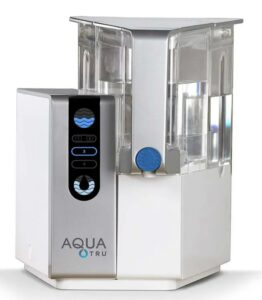
#4 Aquatru Countertop RO System
- Chlorine Removed: 99.0%
- Filtration Method: Activated Carbon
- NSF Certified: Yes

#5 Big Berkey Countertop Filter
- Chlorine Removed: 99.6%
- Filtration Method: Activated Carbon
- NSF Certified: No
Evaluation Criteria
Here are the traits of filters that remove chlorine that I would recommend taking a closer look at when shopping for one.
Percentage of Chlorine Removed or Reduced
If you are purchasing a water filter to remove chlorine from your drinking water, then you better be aware of exactly how good a filter is at doing that.
Chlorine Filtration Method
This is what type of filtration media inside of a water filter is responsible for removing or reducing the chlorine that passes through it.
NSF/ANSI Standard 42 Certification
NSF/ANSI are very well-respected independent testing groups. When a water filter or device has been certified to be NSF/ANSI standard 42 compliant, that generally means it does a good job of eliminating chlorine taste and smell. .
Other Contaminants Removed or Reduced
It’s a nice bonus if the water filter that you purchase to remove chlorine does much more than just that. Especially if it does not significantly increase the price of the unit.
Filtration System Placement
There are two ways that water filters can be installed. These are point of entry water filters that will treat 100% of the water that comes into your home and point of use systems that will only treat the water that you use for cooking, making ice, and drinking.
Best Water Filters for Chlorine Reviewed
In my opinion, these are the best choices of filtration systems when it comes to chlorine removal.
#1 Springwell CF1 Whole House Chlorine Filter

My choice for the best water filter for chlorine removal is this Springwell CF1 Whole House Chlorine Filter.
That’s because it not only filters a significant amount of chlorine out of tap water but it will also perform this operation for 100% of the water that comes into your home.
That means it will not only keep you from ingesting large amounts of chlorine but will also help prevent this chemical from doing such things as drying out your hair and your skin. As a bonus, it will filter out many other water contaminants besides chlorine too.
It’s also a single tank whole house chlorine water filter that makes for an easy DIY installation and the fact that it needs very little maintenance over its expected 10-year lifespan means it’s a great deal despite its high initial cost (currently $772.98 without add-ons).
Pros
- Four-stage filtration includes activated carbon and KDF filter media
- 1,000,000 gallon or 10-year filter lifespan
- 9 GPM flow rate does not impact water pressure
- Filters out chlorine and many other water impurities
- 6-month money-back guarantee
- Lifetime parts warranty
- Free shipping
- DIY-friendly one tank system
- Can add on a water softener and UV light water purification device
Cons
- Not recommended for well water
- High initial cost
- Will not work in homes with more than 3-bathrooms
Main Features & Benefits
- Percentage of Chlorine Removed or Reduced: It’s a whole house water filter that will remove up to 99.6% of the chlorine in the water that flows through it.
- Main Filtration Method: As with all good chlorine filters, it contains a layer of powerful chlorine absorbing activated carbon filtration media that allows for excellent chlorine and other contaminant water filtration.
- NSF/ANSI Standard 42 Certification?: This whole house system does not come with NSF/ANSI standard #42 certification but those that have used it and had their filtered water tested claim to be happy with the chlorine taste and smell removal results.
- Other Contaminants Removed or Reduced: In addition to doing a great job of removing chlorine, it will also remove Chloramines, Haloacetic Acids, Herbicides, Pesticides, VOCs, PFOAs, PFASs, PFOSs, and more.
- Filtration System Placement: This is a point of entry water system, so it will remove most of the chlorine from every single drop of water that comes into your home.
#2 Clearly Filtered Water Pitcher

If you want to remove the majority of chlorine from your drinking water in the simplest and least expensive way, then you can’t go wrong by purchasing the Clearly Filtered Water Pitcher.
When I first researched this water filter pitcher, I was also taken aback by the fact that in addition to highly efficient chlorine removal (99.9%), it also removes some 395 other tap water contaminants.
With the high percentage of chlorine that it removes along with many other water impurities, these easy-to-setup and maintain water filter pitchers are a relative steal at $75.00. It also works better than any faucet water filter.
Pros
- Reduces chlorine by 99.9%
- Uses well-designed 3-stage filtration
- 5 different NSF/ANSI certifications including standard #42
- Made from 100% BPA/BPS-free medical-grade Tritan material
- Does not remove healthy minerals
- Affordable
- USA-made
- 30-day satisfaction guarantee
- Lifetime warranty
Cons
- Short 4-month filter life
- Somewhat costly replacement filters
- Small 80-ounce capacity (10-cups)
Main Features & Benefits
- Percentage of Chlorine Removed or Reduced: Its a water filter pitcher that will remove up to 99.9% of the chlorine that slowly gravity-feeds down through its filter.
- Main Filtration Method: This water filter pitcher uses a well-designed composite shell activated carbon filter to remove chlorine.
- NSF/ANSI Standard 42 Certification?: This filter pitcher not only is NSF/ANSI standard 42 certified but also has NSF/ANSI standard 53, 244, 401, and P473 certifications.
- Other Contaminants Removed or Reduced: Some of the over 395 other water impurities that this remarkable water filter pitcher removes or reduces include lead, mercury, fluoride, glyphosate, arsenic, microplastics, and PFOAs & PFASs.
- Filtration System Placement: This is a highly portable point of use water filter pitcher. You can place it just about anywhere you want since its hand filled and requires no electricity to work.
#3 Clearly Filtered Under Sink Filter

If you do not want to clutter your counter space with a somewhat unsightly water filter that removes chlorine, then this under sink water filter will appeal to you. That’s because a reverse osmosis water filter works well at removing chlorine but stays out of sight while doing it.
It features effective 3-stage filtration that removes 99.5% of the chlorine that enters into it along with 232 other drinking water contaminants. This under sink filter does this while leaving the healthy minerals that pass through in the filtered water it produces.
This under sink water filter also has a space-saving design that allows it to be installed close to the wall and is moderately priced at $450.00, which is not too bad considering its long-lasting 2000-gallon filtration stages.
Pros
- Effectively removes 99.5% of chlorine
- 3-stage filtration system removes or reduces many contaminants
- Retains essential minerals
- Small 3” width allows for close to the wall installation
- 2000-gallon filter useful life
- DIY installation is possible for most
- USA-made
- 30-day satisfaction guarantee
- Lifetime warranty
Cons
- Does not purify hot water
- High initial cost
- You can expect a 20% water pressure drop when using it
- Periodic filter changes area required
Main Features & Benefits
- Percentage of Chlorine Removed or Reduced: 99.5% of the chlorine in the water that enters this filtration system will be removed.
- Main Filtration Method: An included granular coconut carbon filtration stage does the heavy lifting when it comes to chlorine removal.
- NSF/ANSI Standard 42 Certification?: In addition to NSF/ANSI 42 certification, this highly-rated under-sink filter is also NSF/ANSI 53 and 401 certified.
- Other Contaminants Removed or Reduced: This is another impressive water filter that removes over 200 other water impurities including Chromium, VOCs, Arsenic, Fluoride, Pesticides, and More.
- Filtration System Placement: It’s a non-portable point-of-use filtration system that is almost always placed under the kitchen sink.
#4 Aquatru Countertop RO System

Reverse osmosis filters alone do not make for great chlorine water filters but when you combine RO filtration with a good activated carbon filter stage such as this system does, then you have a powerful water purifying machine.
This 4-stage Aquatru Countertop Reverse Osmosis System will remove over 80 drinking water contaminants and that includes a very substantial 99% of the chlorine that passes through it.
It’s a fully-contained water purification system that all you have to do to get it going is wipe it down, plug it in, and then fill it up with water. This water filter will do the rest on its own.
That level of automation combined with its effectiveness somewhat justifies its high initial cost and somewhat pricey replacement filters.
On average its filters need to be changed out every 6-months with the lone exception being its RO filter which should last you 2-years.
Pros
- Time-tested reverse osmosis filtration
- Removes or reduces over 80 water contaminants
- 3 bonus filtration stages
- Fully self-contained unit
- NSF/ANSI 42, 53, 58, 401, 473 certified
- Digital readout
- Stores 1-gallon of purified water
- Pushbutton dispensing
- 30-day money-back guarantee
Cons
- Needs an electrical outlet to operate
- High initial cost
- Hand filled
- Somewhat costly replacement filters
Main Features & Benefits
- Percentage of Chlorine Removed or Reduced: This unit does a real nice job eliminating some of the most common contaminants in drinking water including 98% of the chlorine that passes through the 4 filtration stages.
- Main Filtration Method: Even though this has a great working reverse osmosis membrane inside of it, the activated carbon pre-filter inside of it is what does the work when it comes to chlorine removal.
- NSF/ANSI Standard 42 Certification? Yes, and a whole lot more to include NSF/ANSI standard 53, 58, 401, 473 certifications.
- Other Contaminants Removed or Reduced: This is yet another water filter on this list that will do a whole lot more than just remove chlorine. That includes removing 99% of benzene, 98% of arsenic, and 99% of lead among others.
- Filtration System Placement: This is a point-of-use water filtration device that’s best placed right near your kitchen sink. You don’t have many other placement options with it.
#5 Big Berkey Countertop Filter

Few very simple chlorine water filters can outperform the Big Berkey gravity-fed water filter. It’s a very good countertop filter that’s highly rated by those that have purchased and used it.
It can be set up and working in less than 5-minutes and there is not much fuss when it comes to maintenance either. Drawbacks to it are its somewhat pricey initial cost and the fact that it has to be hand filled but after that, everything else about it is only positive.
This water filtration unit has a good-looking stainless-steel finish and carbon plus filtration cartridges that can go as long as 2-years without needing replacement.
It’s not NSF/ANSI standard 42 certified and that’s part of the reason why those in Iowa and California cannot purchase it.
Pros
- Reduces or removes over 200 contaminants
- Simple but effective
- 3000-gallon or 2-year filter life
- 2.25-gallon storage capacity
- Good looking & tough stainless-steel construction
- Can be portable
- Lifetime product warranty
- Easy setup & maintenance
Cons
- High initial cost for a gravity-fed water filter
- Manually filled
- Lengthy filtration time
- Unavailable in California or Iowa
Main Features & Benefits
- Percentage of Chlorine Removed or Reduced: This highly portable countertop chlorine water filter will reduce the chlorine in the water that passes through it by a whopping 99.6%.
- Main Filtration Method: Its proprietary filters use high-grade coconut shell carbon combined with a blend of 5 other media types.
- NSF/ANSI Standard 42 Certification? Although this gravity-fed tap water pitcher is not NSF/ANSI certified, the company claims that it has been 3rd-party tested to meet or exceed those same standards.
- Other Contaminants Removed or Reduced: list of contaminants that the manufacturer of the Big Berkey countertop filter says it will remove or reduce is an impressive one at over 200 impurities.
- That includes not only chlorine but also chloramines, pharmaceuticals, viruses, pathogenic bacteria, Arsenic, E. Coli, and many Nitrites.
- Filtration System Placement: This is a point-of-use countertop water filter that’s also very portable, so it can be used in a variety of different settings where purified drinking water is needed.
#6 Aquasana AQ-4100 Shower Filter

While most people focus solely on obtaining a water filtration device that removes chlorine from their drinking water, that does not eliminate some other chlorine health concerns. Most notably that it will also dry out your skin and hair.
That’s where this inexpensive shower chlorine water filter can play an important role. Having shower filters in each bathroom with a shower stall will help keep the majority of chlorine that’s present in your tap water from ever reaching your body or your hair.
They can be installed by just about anyone and the filters they use will last around six months to filter water before needing replacement.
These are a welcome addition to your home and best used in conjunction with a quality under-sink filtration system, water pitcher filter, or countertop filter that removes chlorine.
Pros
- Proven coconut shell carbon filter media
- Reduces chlorine by 90%
- Additional KDF 55 filter media
- Up-flow design guards against clogging
- Simple DIY installation
- Does not significantly impact water pressure
- 6-month filter life
- 1-year limited warranty
- 90-day guarantee
Cons
- A little bulky looking
- No filter change indicator
- Pricey replacement filters
Main Features & Benefits
- Percentage of Chlorine Removed or Reduced: The filter media in this device will remove up to 90% of the chlorine that passes through it.
- Main Filtration Method: Activated coconut carbon shell filtration is the key to making this showerhead filter work and it has added KDF filter media too.
- NSF/ANSI Standard 42 Certification: NSF/ANSI 42 does not apply to showerheads but this is NSF/ANSI Standard 177 which is the rough equivalent for showerhead filters.
- Other Contaminants Removed or Reduced: The two types of filter used in the Aquasana AQ-4100 enable it to not only be able to remove chlorine but also lead, iron, and some harmful chemicals.
- Filtration System Placement: This is a point-of-use chlorine filter that you simply need to uninstall the old showerhead and twist on this shower filter in its place.
Chlorine Water Filters Buyers Guide
Why Is Chlorine Added to Our Tap Water?
Chlorine is very popular tor use to treat tap water. So much so that the Environmental Protection Agency (EPA) and CDC estimate that over 60% of the households in the USA have drinking water that has been treated with chlorine.
When chlorine is added to municipal water to sanitize it, this is called Chlorination. It’s very effective at killing such microorganisms as bacteria, viruses, and parasites.
Among the waterborne pathogens that chlorinated drinking water is credited with largely keeping in check are those that cause E coli, typhoid, salmonella, dysentery, cholera, norovirus, and Legionnaires’ disease.
Is Chlorine in Drinking Water Dangerous?
My familiarity with chlorine tells me it’s a substance I would never willingly take into my body even in small amounts over a long time. Unfortunately, that’s what millions of Americans across the country do regularly.
If you have chlorinated water coming into your home and you or your family drink that water without it being treated further, then you expose yourself to many potential health problems.
This includes such minor problems as nausea, headaches, digestive tract issues, watery eyes, and nasal discomfort.
Longer-term effects of ingesting higher than recommended levels of chlorine can produce such severe consequences as pulmonary edema (fluid buildup in the lungs) and lead to bladder, liver, colon, and other cancers.
How Much Chlorine Is Typically in Our Water?
When looking for an answer as to how much chlorine is typically in our water, that’s very hard to say. Because different water sources have different chlorine levels. If you are on well water the answer may even be none at all.
If you are on city water, then there is a very good chance that you have water coming into your home that has been chlorinated before it gets to you.
Testing your water for its chlorine level is the only sure way to know how much chlorine is in your drinking water.
How to Test for Chlorine in Water?
You have many options when it comes to testing for chlorine. That includes everything from tests that just detect the presence of chlorine in your water to others that will test for chlorine and a wide range of other impurities that may be in your drinking water.
Here are the three main ways to test chlorine at home:
- Chlorine Only Test Strips
These are easy-to-use test strips that just measure chlorine levels.

- Chlorine Plus Test Strips
These are test strips that will detect the presence of chlorine and several other water contaminants.

- Professional Lab Testing
You can order a professional lab testing kit online and when the water sample containers arrive, you just fill them up and send them back in. If I am going to take the time to do water testing this is the way to go for me.
That’s because these chlorine test kits will detect the presence of chlorine along with many other harmful impurities that may be lurking in your tap water.
One professional lab test kit that I have had great results when using is the Tap Score Kits.

Which Types of Water Filters Remove Chlorine?
By far the best way to remove chlorine from water is by using a filter cartridge or filter media that contains activated carbon. That’s because chlorine is very hard to filter out of water because of how easily it goes into solution.
Even membranes as small as 1-micron in size reverse osmosis filters don’t do a good job at filtering out chlorine. Carbon filters work because it has a substantial amount of surface area and it absorbs chlorine in water as opposed to trying to filter it out.
You will notice that every one of the best filters for chlorine in the chart above includes carbon filters or granulated carbon media. Carbon filters are also nice because they will usually go 6-months or more before needing filter replacement.
Many people believe that boiling water remove chlorine is possible but that’s simply not the case. So it really takes a good water filtration system to remove chlorine and harmful contaminants from drinking water.
Don’t Take Chances with Too Much Chlorine Consumption
After what you have read here, you are now well aware of the impact that chlorine in drinking water can have on you and your family’s health. It’s especially important to take steps to remove chlorine if you are supplied by municipal water that’s sanitized by it.
So be proactive when it comes to removing chlorine from your drinking water and strongly consider adding a top-of-line whole house chlorine filter such as our #1 choice the Springwell CF1 Whole House Chlorine Filter.
At the very least, think about purchasing a simple point-of-use chlorine filter like the highly-rated Clearly Filtered Water Pitcher to help protect your family from the potentially harmful effects of chlorine and other common water impurities.