Filteredwaterguide.com is supported by readers. If you purchase through referral links on our site, we make a commission at no extra cost to you. Learn more.
Home » Water Filtration Systems » 8 Best Shower Head Filters for Hard Water & Chlorine Reviewed
So you realized that soaking up chlorine and other tap water contaminants you shower in every single day could be having a substantial impact on your health.
You’ve come to the right place.
Your skin, hair, and body can benefit from a showerhead water filter, and it’s a cheaper alternative to a whole-house filtration system.
We’ve tested, researched, and compared the best shower head water filters on their main qualities including the contaminants they filter out, their ease of use and durability, and other key specifications that make a difference.
Below you will find everything you need to know when deciding which shower head is best as well as extensive reviews on our top models.

These are the most critical specifications that you’ll want to compare when considering different shower head filters, and they’re the main criteria we used to evaluate our choices for the best shower filter.
Not all filters are created equal, and not all products are going to work on the same number and classes of contaminants. The types of filtration media that each shower head filter uses are ultimately going to determine the contaminants they work on, and every brand uses its own unique blend of media.
Do you struggle with a high chlorine content from your municipal water supply, or do you have higher levels of heavy metals like iron?
You can find out by getting your water tested with a water test kit, and once you have the breakdown of the main contaminants in your water you’ll be able to tailor your filter selection to your home’s needs.
The filter lifespan will tell you how much maintenance you can expect as well as how much ongoing cost there will be for the replacement filters. The lifespan of a shower head filter can either be described in months or gallons of water used.
You’ll also want to look at how easy the filters are to replace. Will you need a wrench, pipe cutter, and an hour of your time, or five minutes and some elbow grease? You’ll want to make sure you’re not signing up for extra hassle with a filter that’s difficult to replace each time.
If you’ve ever had to take a shower with pitiful water pressure, you know how frustrating it can be to try to rinse off soap and shampoo with minimal flow. Flow rate is one of the biggest determinants of customer satisfaction with a product, so you’ll want to check how much of a hit your water pressure is going to take beforehand.
The material a showerhead filter is made from will determine both its aesthetics and its durability. Plastic may be more prone to cracking than metal, but anything other than stainless steel will have the potential to rust. Some filters also come in different styles and finishes so that you can choose the one that best matches the other fixtures in your bathroom.
Getting independently tested and certified by either the National Sanitation Foundation (NSF) or the Water Quality Association (WQA) is one way that filter manufacturers can prove that their products live up to their claims. It’s an added assurance for the consumer, and there are multiple different quality standards that water systems can be certified for.
With all of our contenders below, no matter where they fall in the price range we made sure that they offer the most value possible for their price. When looking at the price of a shower head filter, you also have to consider both the initial price and the ongoing costs of the replacement filters.
Using the criteria above as our guide, we scoured the products on the market and came up with our picks for the best shower head filters which we review extensively below.

Berkey is a well-known and loved brand in water filtration, but while their gravity filters generally take the spotlight they offer an excellent shower filter as well.
This filter uses a proprietary filtration media that incorporates zinc, copper, and calcium that removes contaminants via oxidation-reduction chemical reactions.
The media blend also kills bacteria and prevents the growth of algae and fungi, so you can be sure that there’s no microbiological buildup or contamination in your filter.
We also did a complete Berkey shower filter review here for more details.
If you want a shower head filter that removes both chlorine and heavy metals, then you should consider this filter. The lifetime warranty means you’re covered if it ever breaks, and the flow rate is high enough to ensure you enjoy your showers.

Coming in second is this filter from Aquabliss, which has the advantage of being able to screw into any existing showerhead.
The filter uses 12 different stages including redox media, calcium sulfite, and activated carbon to remove a variety of contaminants. Unlike some other filters on the list, it actually adds healthy minerals and vitamins C back into the water as well.
It’s one of the top shower head filters on the market and it also looks great. You can see our full Aquabliss shower filter review here.
If you want a shower head that adds some beneficial minerals and vitamin C back into your water for even healthier skin and hair, then this is one of the best shower filters out there. It’s also simple to use and works with your existing showerhead.

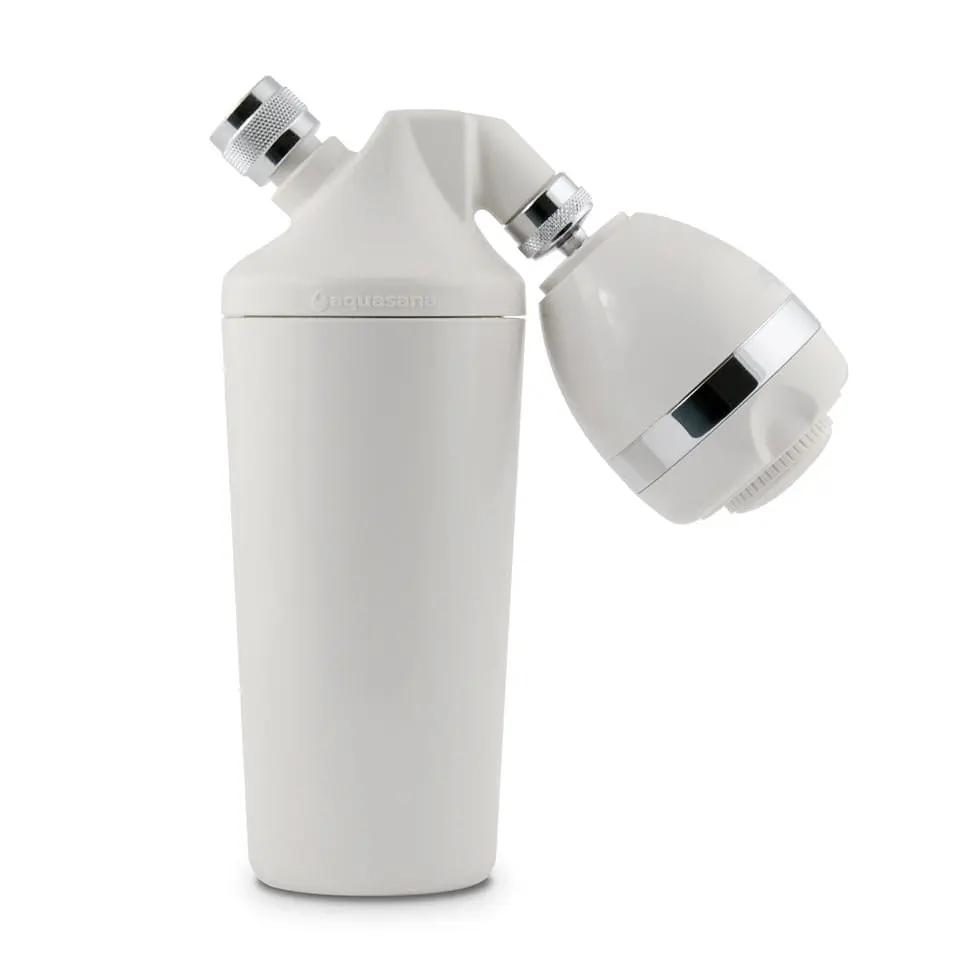
Aquasana is another giant in the water filtration industry, and they produce a line of shower heads in addition to their drinking water filters.
This shower head filter uses a proprietary blend of activated carbon and copper-zinc media for excellent filtration that also improves the pH balance of your water.
See our complete Aquasana Shower Filter Review for more information.
If you have high levels of organic contaminants in your water, then this filter’s heavy-duty activated carbon filter is the one you need. It’s also nice for those who want to match their shower head to their other bathroom fixtures.

This model from Pelican Water is the first one on our list that works on chloramines as well as chlorine, which is another disinfectant used in municipal water supplies.
Activated carbon is combined with copper and zinc media as well as far-infrared in this filter, and it even comes with an aromatherapy bar so that your shower can be transformed into a relaxing experience.
See our complete Pelican shower filter review for more information.
If you want the spa experience from your shower head, this is as close as it gets. It’s also great for those in municipalities that use chloramine in the water, and it comes from a trusted brand. .

One of the most comprehensive filters out there, this filter has 15 stages of water purification and likewise adds back healthy vitamins and minerals like vitamins C and E.
It’s one of the only shower head filters that’s rated to remove fluoride, and it also comes with an extra filter cartridge in the package
This is a cheaper alternative to some of the other top models that also works to soften your water while adding vitamins. You won’t get a better value for the price of this model.

Culligan is yet another big name in water filtration, and they make multiple different shower head filters.
This one is the most streamlined design on the list where you can barely tell there’s a filter incorporated, and it even has five different spray settings.
The filter itself uses a proprietary filter media that is bacteriostatic.
This is a good choice for those who don’t have a high number of contaminants in their water and want to improve its hardness while getting rid of chlorine. It’s also a great price for everything that’s included.
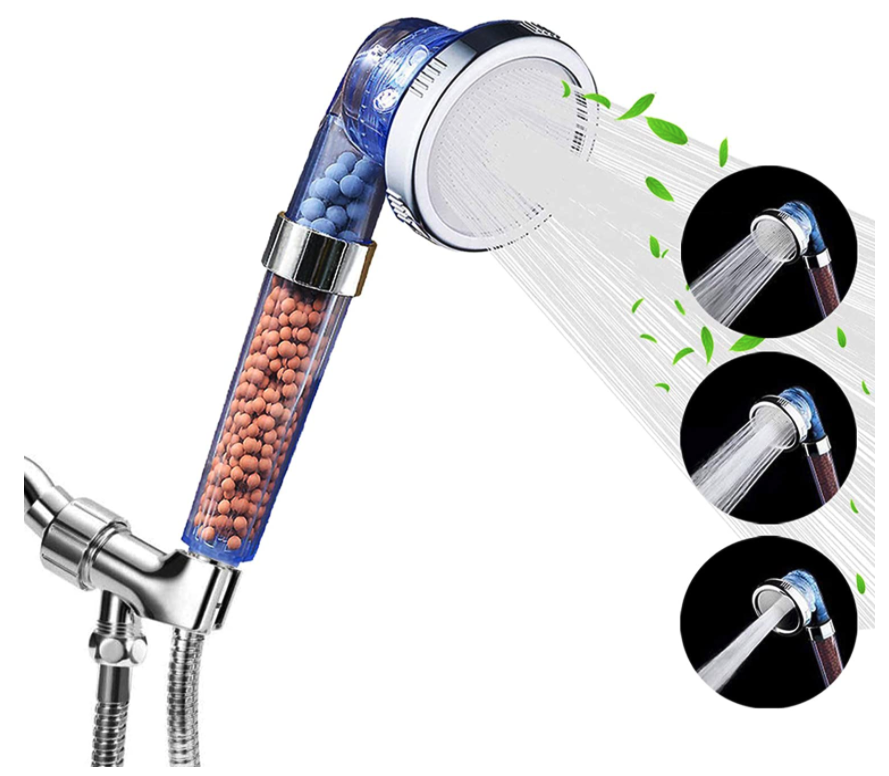
This filter takes a different approach to filtration, using gray mineral stone beads to put healthy minerals back into water and using red natural stone beads for filtration.
The unique design of the showerhead allows it to achieve high water pressure with a lower flow rate.
You can see our full Luxsego shower filter review for more information.
If you want to save water without compromising your pressure, this showerhead gives you the best of both worlds. It also looks great hanging in your shower, and it’s an all-natural approach to water filtration.

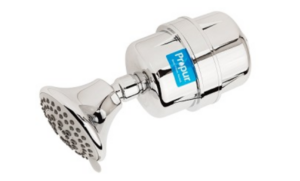
Our final product comes from Propur, who just recently rebranded to ProOne.
This filter is the most comprehensive when it comes to contaminant removal, and it does it with proprietary infused-microstructure filtration media in multiple stages.
If you have high numbers of contaminants in your water, this is the only shower head on the list that will leave your water at drinking-level purity. Even better, it doesn’t put much of a dent in your flow rate to accomplish it.
| Product | Contaminants Removed | Filter Lifespan | Flow Rate | Certifications | Price |
|---|---|---|---|---|---|
| Berkey Shower Filte | Chlorine, heavy metals, bacteria | 12 months | 2.5 GPM | - | $$$ |
| Aquabliss High Output | Chlorine, pesticides, scale | 6 months | 2.5 GPM | - | $ |
| Aquasana Shower Filter | Chlorine, heavy metals, organic chemicals | 6 months | 2.5 GPM | NSF | $$$ |
| Pelican Premium Shower Filter | Chlorine, chloramine, organic chemicals | 9 months | 1.5 GPM | - | $$ |
| AquaHomeGroup Shower Filter | Chlorine, fluoride, scale, heavy metals | 6 months | 2.5 GPM | - | $ |
| Culligan WSH-C125 | Chlorine, scale | 6 month | 2 GPM | NSF, IAPMO | $ |
| Luxesgo Ionic Shower Filter | Chlorine | 6-8 weeks | 1.46 GPM | - | $$ |
| Propur ProMax Shower Filter | 200+ contaminants | 6 months | 2 GPM | - | $$$ |
Now that you know the top models on the market, these are the other details and tidbits that can help you make the best decision on a shower filter for your home’s needs.
Shower head filters are considered point-of-use systems, which means that water is filtered only at a single exit point – your shower – rather than through the whole house.
There are two main types of shower head filters: those that are incorporated into the showerhead, and those that are separate.
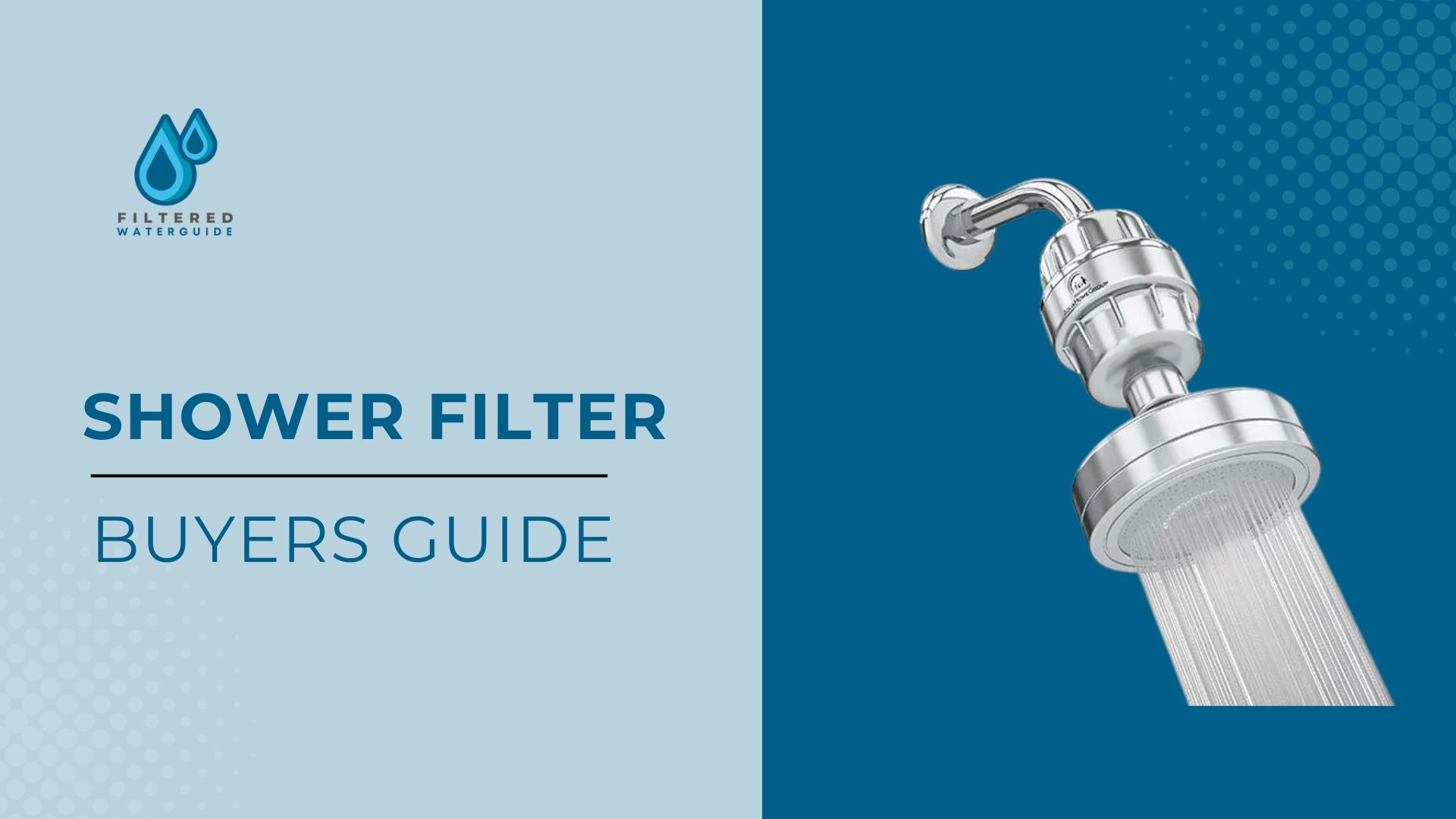
Incorporated shower filters are built into the body of the shower head so that it’s all a single part.
These filters are also referred to as inline shower filters where they screw in with the existing shower head.
Some manufacturers will only add filters to a single showerhead type, while others will give you the option to choose between multiple different styles including shower wands.
There are also some models, like the Berkey Shower Filter, where the filter isn’t built into the actual showerhead but it still comes as a single unit.
Unlike incorporated shower filters, these products don’t come pre-attached to a showerhead.
Instead, they are usually equipped with ½ inch fittings that make them able to fit into almost any existing shower head setup. You would simply install the filter prior to installing the showerhead. These can be fairly streamlined or they can be rather bulky depending on the manufacturer.
Shower filters are made to remove the contaminants that are going to have the biggest effect on your skin and hair – which is namely chlorine and harness-causing minerals.
The exact contaminants a showerhead filter removes are going to depend on the filter it uses, and below are the most common filtration media used in these products.
This media is usually found in the form of kdf filters or copper-zinc granules. It works by either oxidizing (taking an electron from) or reducing (adding an electron to) the different ions that come across it in the water. This makes it especially good at removing heavy metals like lead and mercury.
A staple in the water filtration industry, activated carbon is made from a carbon source that has been heated to extremely high temperatures and treated chemically with argon and nitrogen.
This causes the carbon particles to become extremely porous and have massive surface areas to bind contaminants with, and they also have the ability to electrostatically trap contaminants.
Activated carbon is great for removing chlorine and other impurities that cause foul odor, and it works best on organic contaminants like herbicides, pesticides, volatile organic chemicals, and some pharmaceuticals.
This is a catch-all term for anything that filters by making holes that the contaminants are too large to pass through.
In this regard, activated carbon can be considered a form of microfiltration. You can have a very wide range of pore sizes – from 5 microns down to 0.05 microns – so the exact contaminants removed will depend on how fine the filtration media is.
Vitamin C shower filters are mainly included in the filtration media of shower water filter system because they are very effective in removing chlorine and chloramine as well as other sediments.
The best vitamin c shower filters can remove up to 90% of chlorine so if chlorine is a contaminant you’re dealing with take a look at shower head units with a vitamin c filter.
Another catch-all term, this just means that the manufacturer has come up with their own blend of filtration media that may work via several different mechanisms – and they’re not sharing the trade secrets.
Unless you’re drinking your shower water, you shouldn’t have nearly the risk of negative health effects with unfiltered water in your shower as you would for drinking.
Having said that, there are still multiple negative effects associated with showering in unfiltered water, and each contaminant culprit is broken down into more detail below.
Chlorine is a commonly added disinfectant in municipal water supplies. It exists in two main forms in water: free chlorine, and chloramines. Free chlorine is what it sounds like – unbound chlorine atoms that generally ionize into chloride.
Chloramines, on the other hand, are what is formed when chlorine forms chemical bonds with other elements and molecules. Due to its structure, chloramines are much harder to remove from water than regular chlorine.
Chlorine can cause skin irritation in high quantities but you’re highly unlikely to encounter chlorine at a level high enough in your shower water for that to happen. That means you’re good, right?
Well…not quite.
It can strip your skin and hair of its beneficial oils, leaving your skin dry and your hair dry and brittle.
Over time, it can also cause color-treated hair to turn various shades of green. The worst potential effect of chlorine is when it comes out of the water as vapor and gets inhaled. This can cause respiratory irritation and trigger asthma.
Like chlorine, hard water is also associated with skin irritation.
Hard water is caused primarily by calcium and magnesium ions in the water, which precipitate out and accumulate as scale. Scale is drying to the skin and hair, and it can even clog pores to make acne and eczema flares more common. In your hair it can also contribute to dandruff and scalp irritation. This is because, like chlorine, hard water removes your natural oils.
Scale also prevents soap from lathering properly, so you’ll often find yourself using more soap, detergent, shampoo, etc than you would with soft water. As scale builds up on our fixtures and in your appliances, it can cause your water lines to become clogged and can shorten the lifespan of your water heated, dishwasher, etc.
A shower filter will improve the health of your skin and hair, and your water will smell better and feel smoother as you shower. Below are the main benefits of installing a better shower head.
Shower filters often soften water which will prevent the negative effects from calcium and magnesium minerals, and this will keep your showerhead from being clogged with scale as well.
Removing chlorine will also benefit your skin and hair and remove the risk of inhaling the vapor, while making your water smell less like a swimming pool.
Young kids are more susceptible than adults to the negative effects of chemicals like chlorine in water, and removing these chemicals will lower their risk of respiratory diseases like asthma.
Chlorine isn’t the only chemical that makes water smell unpleasant, and many filters also work on the other culprits like zinc, hydrogen sulfide, herbicides, pesticides, and microorganisms.
If you run on well water, your filter may still let some iron and hydrogen sulfide come through the system. A shower head filter would help prevent the orange staining and foul odors that might slip through.
Also, some shower filters work to prevent the growth of or even kill some microorganisms, which is definitely an added benefit.
The damp environment created by residual water in the showerhead and filter can be a breeding ground for bacteria, mold, algae, etc, so getting a model that prevents that growth will help ensure your filter lives up to its potential.
Choosing the best shower head filter can feel like a tall order, especially with all of the different products on the market.
You want a filter that will remove the main contaminants in your water (and is preferably certified to do so), won’t require a lot of maintenance, will maintain your water pressure, and won’t break the bank.
Let’s look at each of those a little bit closer.
As mentioned, having your water tested to see what contaminants are present is the best way to ensure you’re choosing a filter that will address your home’s specific needs. This will help you decide if you need a workhorse like the Propur Promax that removes an extremely large number of contaminants, or if you can go with a different filter that may have other benefits.
The main contaminants you’ll want to remove are the ones with potentially negative health effects like chlorine and hardness – if they’re present in your water. You can see our choices for the best water testing kits here.
Once you know what contaminants you need to get out of your water, you can look for a filter that’s certified to do so. Keep in mind that while certification is the gold standard for water filters, many choose to have their products tested through independent labs without paying to go through the certification process.
The tests are often performed with the same standards they would be certified for, so it’s a way that manufacturers can guarantee their products without having to pay extra for the certification.
We discussed the lifespan of filters being in months or gallons, but the two are not always created equal. The lifespan in months will vary from one household to another due to variations in usage, while the lifespan in gallons is the more universal measurement. For example, a family of four that showers twice a day will go through water much faster than a family of two that only showers daily.
Most shower filters have one of two methods for replacing their filters: they screw out, or they pop out. Both are very quick and simple to use fortunately, and you shouldn’t have much of a problem doing filter replacements. You’ll still want to check, though, in case you come across a filter that is going to be a hassle to replace.
There’s a government regulation that states that new showerheads cannot have a flow rate over 2.5 GPM, so this is the maximum and the goal for shower filters. Most showerheads accomplish this with a restrictor placed somewhere in the model, though forcing water through a filter naturally wants to reduce its flow.
In order to keep from experiencing any of the headaches that come with low water pressure, you’ll want to get a shower filter with the maximum flow rate or close to it.
As mentioned, the price of a shower head filter is two-pronged: what you’ll pay now, and what you’ll pay down the road for replacement filters. A system with a high up-front price but long filter lifespans may save you money over time compared to a system that is less expensive up front but requires more maintenance.
Shower head filters come in many different styles and designs, and they’re often available as just the filter so you can use them with your own head.
You’ll want to make sure the filter you choose matches up with the other fixtures in your bathroom.
With the design, you’ll also want to make sure the filter isn’t going to lower the height of your showerhead beyond what is practical for you.
Don’t forget to look into a product’s warranty as you’re browsing as well. Some models like the Berkey will come with a lifetime warranty, while others will only last for months to years. This can give you an idea of the expected durability of the shower head filter as a whole, and nobody wants a system that’s going to break soon after purchase.
As with anything, customer reviews can also give you great insight into what day-to-day use looks like, and what the consistent problems are that customers seem to run into.
The only tools you’re likely to need are teflon tape and a pair of pliers, but note that the pliers are for removing the old shower head only.
Overtightening your new filter can lead to leaks, so you’ll usually just want to hand-tighten those.
Unscrew the head by rotating it counterclockwise, using the pliers if required.
Once the old head is off, remove the cap on the filter outlet if applicable and apply teflon tape to the threads on the shower arm. You can then screw the filter onto the arm, making sure that any gaskets and washers in the filter are seated properly.
Most shower filters recommend that you do not use them with a shut-off valve, and if your shower arm does come with one they recommend installing the filter after the valve. This will prevent water pressure from accidentally building up in your filter and damaging it.
Once you get your filter in place, run some water through the filter to flush it for 10-20 seconds, then wrap teflon tape on the outlet of the filter. Screw the shower head back onto the filter, likewise making sure all gaskets are in their proper place. If your filter is built into your showerhead, you would have been done after step 2 and would have just needed to flush it by running some water through.
If you only want your shower water filtered a shower filter is the better choice. If you want all the water in your whole home filtered go with a whole home filter.
A shower water filter may reduce water pressure slightly due to the filtration but if you pick a good model it won’t reduce your flow rate enough to impact your shower. Make sure to check out the GPM rating that the filter provides.
The shower water filter works instantly. Once you turn your hot water on and it flows through your shower head the water will be filtered before touching your body.
There are a few reasons why this could be happening. It could be the case that your filter is not working anymore and it’s ready for a change. It also could be because you just installed the filter and it needs a little more time for the filter cartridges to wash out before it’s ready to operate which is making the water cloudy.
Check the manufacturer’s guidelines to determine how long your filter lasts and when you need to swap it out. Usually, the time range is between 6-12 months before needing to change the filter cartridges.
Showerhead filters are a great way to improve the quality of your water by removing chlorine, harmful minerals, and other contaminants with negative health effects.
We believe that the Berkey Shower Filter is the best product on the market due to its effectiveness, lifetime warranty, and maximal flow, though there are other excellent filters to consider in our review.
Getting your water tested is the best way to ensure your chosen filter will work on the contaminants specific to your water, and you should also look at other factors like the filter lifespan and the design of the unit to make sure you’re getting the best filter for your home.

15657 N Hayden Rd #1162
Scottsdale, AZ 85260
United States
602-780-2598
© Filtered Water Guide
Filtered Water Guide is a participant in the Amazon Services LLC Associates Program and other partner programs, which are affiliate advertising programs designed to provide a means for sites to earn advertising fees by referring users to merchant stores.