Filteredwaterguide.com is supported by readers. If you purchase through referral links on our site, we make a commission at no extra cost to you. Learn more.
Freshwater is one of the most valuable commodities in the great outdoors, and it’s critical to have a clean, reliable supply when it matters most.
We took the top portable water filters on the market and evaluated them on their main features like weight, filtration speed, and price, and then compared them head-to-head.
Whether you’re camping for a month, hiking over a weekend, or you’re simply planning ahead in the event of an emergency, our in-depth review and buyers guide will help you choose the best portable water filter for your needs.





There are seven key specifications we believe have the biggest impact on how well portable water filters perform, and each one is detailed below.
Your water filter is there to keep you safe from the contaminants of natural water, so you’ll want to look for products that work on a wide range of common contaminants.
The ideal filter would remove microorganisms like bacteria, protozoa, and viruses while also reducing any metal or chemical contaminants that may be present.
Whether you’re a backpacker trying to shave every ounce possible or you’re a more casual camper, the weight of the filter is going to largely determine its portability.
If it’s too awkward or heavy to bring with you comfortably then it doesn’t matter how well it works otherwise.
Nobody wants to get out into the wilderness and end up wrestling with their water filter. Look for designs that are intuitive, don’t require excessive setup or priming, and have filter cartridges that are easy to replace as well.
Some portable filters work instantaneously, letting you use them as a straw so you don’t have to wait for the water to filter through the system.
Other systems can take a painfully long time to filter even a small amount of water. You’ll want a filter that won’t leave you waiting, especially if multiple people are going to be using it at once.
The filtration capacity in gallons or liters is a measure of a filter’s lifespan. While how many people use it and the frequency will affect how long it lasts, you can be sure that a filter with a 1,000-gallon capacity will last for longer than one with a 100-gallon capacity
The National Sanitation Foundation and the Water Quality Association are two independent laboratories that test and certify water filters for specific industry standards.
A product that is tested and certified for these standards is an added assurance for the customer that it’s going to perform as advertised.
Price will almost always be a consideration and we looked for the products that give you the most bang for your buck. Keep the cost of replacement filters in mind as well, because some models may end up costing you more down the line than others.
Using the criteria above, we’ve come up with our list of the best portable water filters on the market.
Our top pick is this small, hardy system from Sawyer. It uses hollow fiber technology and orients the tubules in a U-shape to achieve stellar filtration.
It’s also one of the more versatile products on this list, and almost never has to be replaced.
It’s easy to use, ultralight, and won’t break the bank. We think this is a solid filtration system for outdoor activities and other portable uses.
The versatility of the Sawyer Mini filter means it’s perfect for just about anyone. The lightweight design makes it ideal for backpackers, while the water bottle attachment and bladder add even more utility. If you want a filter that will last you a lifetime for a great price, then this is the one you want.
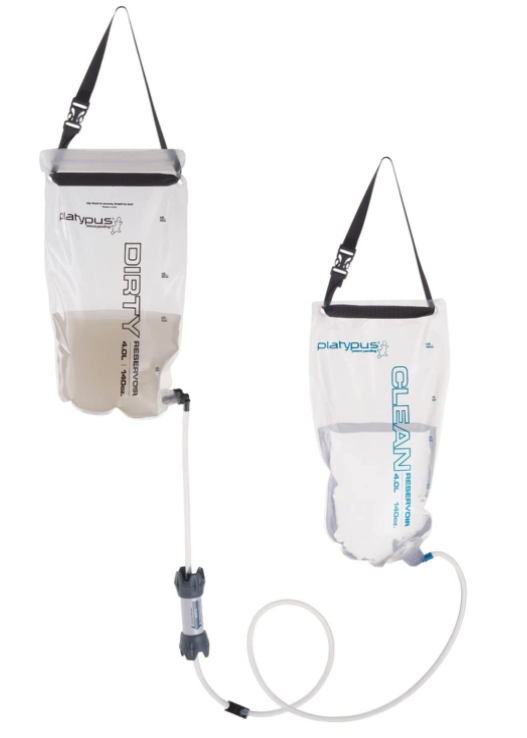
Claiming second is this portable water purifier from Platypus which uses hollow fiber gravity filtration technology to make your water safe from the most common microbes.
The Platypus claims to meet NSF guidelines for bacteria and protozoa removal but they don’t specify an NSF certification.
This water purifier can filter around 1.75 liters of contaminated water per minute, it has BPA-free materials, and it’s designed to last for over 1500 liters of water.
It has an intuitive and lightweight design, and it comes with a lifetime warranty against manufacturer defects
This system is ideal for those who need to store filtered water for later use with its four liter holding capacity. It would also work well for those who plan to camp in a larger group.

If you would prefer a filter that’s already built into a water bottle, then this model is our top pick.
It uses an Ez-Clean hollow fiber membrane to filter water as you drink it, and the bottle itself is collapsible for easy storage.
This filter removes bacteria, cysts, and sediment with a pore size of 0.1 microns. It has a 1000 L capacity and is made of 100% BPA free materials so you can be sure the plastics are not contirbuting to contamination.
If you want the flexibility of a bladder with the utility of a water bottle, then this is a great system. It’s both lightweight and doesn’t require backflushing, and you won’t have to worry about storing a bulky bottle.

Possibly the most iconic portable water filter on the market, the LifeStraw was a pioneering technology developed to provide clean water to people in some of the poorest countries in the world.
It uses hollow fiber membrane microfiltration and is ideal for single-person usage.
If you want a solo filter that is highly effective and will last a fairly long time, this is definitely a product to consider. You also get the warm-fuzzies that come from supporting the Vestergaard charity.

Etekcity (quite obviously) used the LifeStraw as their muse when they designed their own filter straw, and the result is also worthy of consideration.
Like the other filters it uses hollow fiber ultrafiltration, but it also combines that with carbon filtration and ion-exchange resin.
This is a great alternative to the LifeStraw because it filters out organic contaminants and it’s more convenient to use. It is more expensive and requires more maintenance, however, so if you don’t necessarily need the organic contaminant filter you’ll save money with the LifeStraw.

You’re not going to take this beast backpacking, but it works excellent for a more stationary setup like a basecamp.
The Black Berkey filters use activated carbon, microfiltration, and ion exchange resin to achieve some of the most thorough water filtration on the market.
If you have a base when on the go then this Berkey gravity filter is one of the best to consider
Like we said, you won’t be bringing this filter up the mountain with you but it does work very well for a stationary camp site. It can provide clean water for multiple people, and you can rest assured the water is about as pure as it gets.
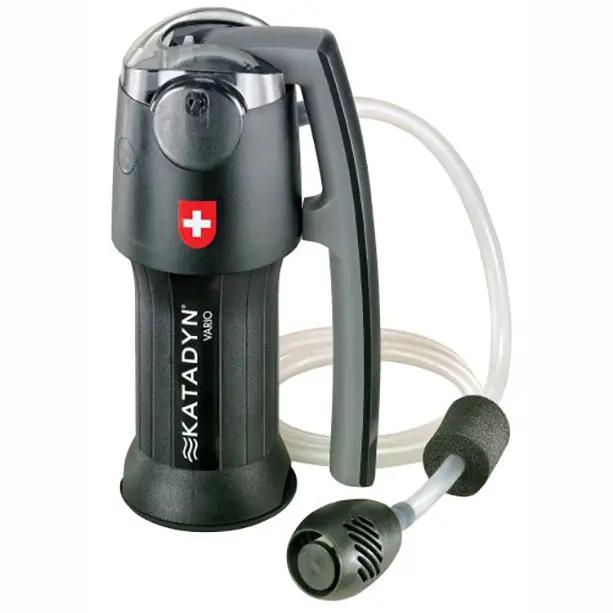
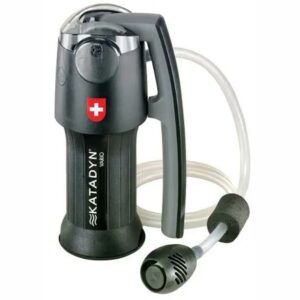
Another Katadyn model, this filter uses pleated glass-fiber microfiltration as well as carbon and ceramic and it works on a wider variety of contaminants than many of the others.
It has dual-piston pumping technology to aid with output, and multiple other features built-in as well.
If you want a filter that has more bells and whistles and you don’t mind paying a little extra for them, then this is definitely one of the fanciest filters on the list. Due to its heavy design, however, it’s also best for those who will be doing lighter camping.

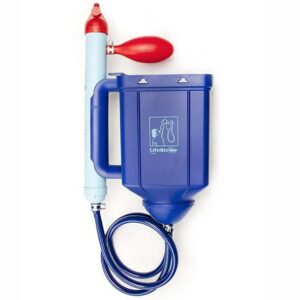
This filter uses the same membrane ultrafilter technology as the original LifeStraw, but they’ve converted it into a filter that can support an entire family.
If you need to provide enough purified water for multiple people but you want something that’s lower profile than the Travel Berkey, then this is a good alternative.

This filter uses ceramic and carbon filtration in addition to Aquatabs when viral contamination is a concern.
It also incorporates pump action like the Katadyn Vario to pull water through the system.
If you want a filter that’s effective against viruses and pumps water instead of relying on suction or gravity, then this is a good alternative to consider. It’s also great for filling up backpack reservoirs and other storage bladders.

This filter comes in as an honorable mention because it’s arguably the best portable UV purifier on the market.
Having said that, unless you’re looking specifically for a UV filter, the others on our list are generally more reliable.
This purifier is best for those who are worried primarily about microbial contamination in their water. The UV light will make your water safe to drink, but you’ll have to make sure you’re not getting it from sources with a lot of sediment, particulates, or other contaminants.
| Product | Contaminants Removed | Weight | Filtration Speed | Filtration Capacity | Price |
|---|---|---|---|---|---|
| Sawyer MINI | Microbes, particulates | 11.5 oz | 1.75 L/min | 1,500 L | $ |
| Platypus GravityWorks | Microbes, microplastics, particulates | 2 oz | Not Published | 378,541 L | $$$ |
| Katadyn BeFree | Microbes, particulates | 2.3 oz | 2 L/min | 1,000 L | $$ |
| LifeStraw | Microbes, microplastics, particulates | 1.62 oz | Not Published | 4,000 L | $ |
| Etekcity Filter Straw | Microbes, organic contaminants, heavy metals, particulates | 2.08 oz | Not Published | 1,500 L | $ |
| Travel Berkey | 232 contaminants in all classes | 6 lb | 0.05 L/min | 22,712 L | $$$$ |
| Katadyn Vario | Microbes, organic chemicals, particulates | 15 oz | 0.5 L/min | 1,875 L | $$$ |
| LifeStraw Family | Microbes, microplastics, particulates | 18.8 oz | 0.2 L/min | 18,000 L | $$$ |
| MSR Mini Works | Microbes, particulates | 16 oz | 1 L/min | 2,000 L | $$ |
| SteriPen Opti UV | Microbes | 3.8 oz | 1 L/min | 8,000 L | $$$ |
Now that you’ve seen our top picks for portable water filters, we’ll break down what you need to know to make the best decision for your needs.
The best portable water purifiers use a triple filtration system called hollow fibers where the water collected (i.e. from a lake) must pass through a series of filters which progressively decrease in size.
Hollow fiber filters have smaller and smaller holes for the fluid to pass through, bacteria, contaminants, and sediment particles are caught within the filters while the water molecules pass through.
There are purifiers that can use UV to sterilize water, and some filters will incorporate other filtration methods as well.
Activated carbon, ceramic, and ion exchange resin are the other filtration methods you’re likely to come across.
Most of the portable water filters are also gravity filters, which means they use gravity to propel water through the multiple layer filtration system.

Depending on where you are in the world and where the water you want to drink is coming from, possible contaminants range from bacteria such as E. coli and Legionella, viruses such as Hepatitis A, and any number of parasites including Cryptosporidium and Giardia.
Aside from the bugs and viruses in the water which could make you sick, many water sources are also polluted with heavy metals, sediments, and microplastics – none of which are going to boost your health.
The exact contaminants a filter removes will depend on the type of filter it employs, but any portable water filter designed for outdoor use should at least purify water and make it safe from microorganisms.
If you need water and you’re closer to nature than you are to a faucet, you probably need a portable water filter.
Hugely popular with outdoor lovers, portable filters have been used for everything from hiking and camping to survival expeditions and disaster relief. They have even been shipped to some of the poorest countries in the world to provide clean water in areas without reliable wells.
Many people leave portable water purifiers in their cars in case they ever get stranded, include them in emergency kits, and even use them as an alternative to other filters for reducing their bottled water consumption.
Lastly, straw water filters and pump water filters are the best backpacking water filters for those out on the trail or traveling to remote areas who are in need of water purification.
Portable water filters come in multiple different forms, but most will fall under one of the following categories.
With no water to store, straw-filters are usually the lightest and most compact portable water filters available. This makes them a firm favorite with hikers and campers looking for a low-tech, easy option to filter drinking water on the go.
The name gives away the way you’re going to use these devices – simply dip one end of your straw filter into the water you want to clean and suck… the suction generated draws the dirty water through the filter inside the straw, and you get clean drinking water on the other end.
Straw filters can be hard work due to the resistance from the filter inside and they can only be used where there is safe access to the water’s edge. However, for a cheap and easy method of purifying water for a day in the woods, a straw filter will make sure you don’t go thirsty.
Pump filters aren’t as small as other portable water filters that are available, although they’re compact enough and light enough to take for short hikes or camping without being too much of a burden.
Using a lead line from the stream or lake supplying your water, a hand pump is used to draw water through the filter and into the reservoir.
The filters in these units can often be cleaned and can lend themselves to a longer lifespan than some other types of filter. Having said that, they are often not as effective at removing some contaminants – like viruses.
Filtered water bottles work on the same principle as straw filters in that before it reaches your mouth, water must pass through a filter that removes contaminants, bacteria, and other elements which you’d rather keep out. The bottle is filled with dirty water from the source, and the water is filtered as you drink. These are great for trips where you want to be able to take some rations with you if you find water.
Brilliantly simple in their design, gravity filters are one of the best camping water filters. They’re well-suited to situations where a semi-permanent camp will be set up and the device can be hung up and left to work, or the water needs to serve a group rather than an individual.
A reservoir is filled with dirty water, which – depending on the brand – then flows down through a series of filters. Contaminants are removed at each stage of the process. Once the water has passed through all of the filters, the clean water fills a second reservoir that is attached to a dispenser.
These filters aren’t the most practical for day trips, but where they can be set up and left they take the hassle out of water filtration in the wilderness. Similarly, they can be deployed to provide portable water filtration systems for disaster-relief situations and fitted as semi-permanent water treatment systems in poorer areas of the world where water cleanliness is lacking.
UV filters are the most “high-tech” of the filter types we have reviewed, requiring batteries to work. Their advancement is often their downfall – and many adventurers prefer alternative types of portable water filters rather than rely on batteries in a survival situation.
Extremely effective at killing bacteria and parasites in the water supply, portable UV water filters operate using the same technology and principles as domestic UV filtration systems, only miniaturised for use on the go.
In remote wildlife settings where the main water concern is sickness from bugs in the water, these units are excellent.
However, this method of filtration does not actually remove contaminants from water, and very dirty water hampers the effectiveness of the filtration process. This means that the water may still be unsafe, even after treatment, if it’s too murky.
These are the things that will have the largest impact on your satisfaction with a particular water filter. Many of these criteria are also what we used to judge the products on in our review.
It sounds obvious on paper, but if you don’t check the weight of your portable water filter you could regret the decision when you’re carrying more weight than you need through the wilderness.
Of course, this is most relevant for those who plan to take their water filters with them on the go. If you’re planning to leave your filter at your base camp and take small hikes out and back, then weight becomes less of an issue.
Put simply: How fast does your filter work? If you’re using a bottle-type filter this isn’t so important, but when using gravity and pump-type filters the filtration speed will dictate how long you’re waiting for clean water. This could be crucial if you have to cover ground quickly or get bedded down in bad weather… you don’t want to be waiting for a drink!
For pump and gravity-types, this will decide how long your filter will last before it needs to be replaced. For bottle-type or bladder-type water filters, this will govern how much water you can carry as well as how long the filter will last. Filters with larger capacities will be able to work for longer without needing to be replaced, which will save you both hassle and money.
This should be obvious but very often you can’t know this until you’re hands-on with a filter… which is why we’re here to help!
This is the difference between whipping out your LifeStraw and kneeling next to the water to have a drink, versus rigging up a gravity filter in a tree, finding a container, transporting water from the source to the filter and then waiting while the clean water collects.
It often isn’t the most important factor in your decision on which portable water filter to buy, but it will certainly influence how happy you are with your filter after 12 months.
It doesn’t matter how awesome a piece of gear is if you can’t afford it. Our review guide has looked at portable water filters for a range of budgets to make sure that you can find a filter to suit your needs, and your wallet.
Whether you’re putting your portable filter in your backpack for a hike or the trunk of your car for emergencies, the size is going to matter.
Backpacking water filter reviews are often the best place to see the importance of size considerations. You’ll need to balance the size of your portable water filter with the size of your pack, the amount of water you are likely to need from it, and the other gear you’re going to carry.
If you’ve been using the same portable water filter for a while, then chances are you have a good idea of how it should feel to use and how long it should take to work.
A change to what you are expecting is usually the first sign that your filter may need replacement. With a gravity filter, it might be that it’s slower to process all of the water while a bottle filter might start to give you drinking water with a slight off-taste. Discoloured water is also another good sign that your filter needs cleaning.
The manufacturer will always issue guidance on how long you can expect a filter cartridge to last. If you’ve cleaned your filter following the instructions provided and it is still not performing, chances are you need a new one.
We always recommend cleaning a portable water filter after every use, especially when it has been used outdoors. For filters kept for emergency use, we’d recommend cleaning them once a month if stored dry. If filled, clean and change out the water at least weekly.
Backpacking and camping have different requirements for a portable water filter. When camping, you have the option of setting up a gravity filter – one which you can leave to work and take the filtered water with you when you pack up the next day – or you can also use a pump filter if a source is nearby.
With backpacking, ease of use and speed of filtration are important – the last thing you need is to be forced into stopping or long periods so that you can set up and treat water for drinking. Bottle and straw types are the most convenient for use on the go.
In reality, most natural water sources are not safe to drink out of. This is because most rivers, lakes, and streams contain plenty of bacteria, viruses, and protozoa. These microorganisms get into water sources from runoff, human pollution, and waste treatment plants.
Potable simply means water that is safe for humans to drink. When you have raw unfiltered water from a lake it would be considered not potable but when you boil or filter it that would be considered potable.
No, there are no legal standards for portable water filter manufacturing and selling. When doing your research look for portable water filters where the company explains in detail how they work, what type of filtration they use, and if they have any NSF certifications to backup their claims.
The safest way to purify water is with reverse osmosis, uv filtration, ultrafiltration, or an activated carbon filter. Some systems use a combination of these filters. The best filters have been certified to remove both microbiological contaminants and chemical contaminants.
Yes, the Lifestraw claims to remove 99.99% of all viruses, bacteria, and protozoa.
Portable water filters are a critical piece of equipment for anyone who spends time away from civilization, or those who want to be prepared in case of an emergency. With so many portable water filters on the market, you are guaranteed to find one which suits your needs if you take the time to research the products and give some thought to how you are actually going to use the filter in the field.
Using multiple specifications to judge the top products by, we believe the Sawyer Mini is the best portable water filter on the market because of its effectiveness, portability, and versatility.
No matter what you’re planning to use it for, there’s a portable water filter out there that will work for you. We hope our review and buyers guide has given you a headstart in making your decision.

David is an expert in all things plumbing, heating, cooling, and water treatment. He got his start in the plumbing business working on fixing all types of home improvement issues including water leaks, broken toilets, appliance installation, and more. Over time, he learned a ton about installing and choosing the correct water treatment products for homeowners.
15657 N Hayden Rd #1162
Scottsdale, AZ 85260
United States
602-780-2598
© Filtered Water Guide
Filtered Water Guide is a participant in the Amazon Services LLC Associates Program and other partner programs, which are affiliate advertising programs designed to provide a means for sites to earn advertising fees by referring users to merchant stores.